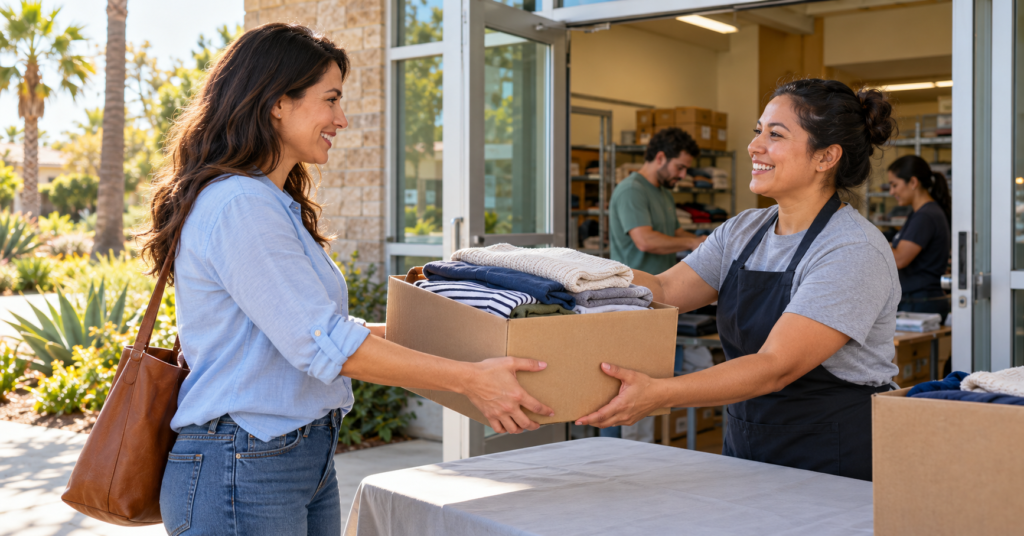
California clothing donations go more smoothly when you match the items to the collection site before leaving home. A bag of wearable shirts, damaged towels, and worn-out shoes may require more than one destination.
Donation centers, community clothing programs, and textile collectors can have different purposes and acceptance rules. Even locations operated by the same organization may have different storage limits or collection arrangements.
Start by sorting what you have, checking the recipient’s current instructions, and planning a handoff during accepted hours. These steps help keep useful clothing in circulation without leaving the receiving organization to manage unsuitable material.
Separate Wearable Clothing From Damaged Textiles
Look through each item before putting it into a donation bag. Check seams, fastenings, stains, odors, and missing components.
A practical first sort creates three groups:
| Item condition | Next step |
|---|---|
| Clean, wearable, and complete | Look for a clothing donation program that accepts it |
| Usable after a small repair | Decide whether to repair it before donating or keeping it |
| Too worn for ordinary use | Find a collection program that explicitly accepts damaged textiles |
Keep uncertain items aside until you have checked the destination’s policy. A collection point advertising “clothing donations” may be seeking garments suitable for immediate wear or resale.
If a small repair would make a favorite item useful again, TCG’s guide to California repair cafés explains how to find community events and check whether clothing-mending help is available.
Confirm What the Specific Location Accepts
Read the current instructions for the branch, collection event, or bin you intend to use. General information about an organization may not reflect the arrangements at that location.
Ask about categories that commonly need separate confirmation, including shoes, underwear, uniforms, bedding, pillows, and fabric scraps.
Describe condition clearly. “Do you accept clean shirts with small holes?” is more useful than asking whether the organization accepts textiles.
Some local programs make a specific distinction between reuse and broader textile collection. For example, RecycleSmart’s Reuse and Cleanup Days guidance lists dry clothing regardless of condition among accepted items. That is a program-specific instruction, not a rule for every California donation center.
If you have several bags, mention the approximate quantity. A small community program may need to arrange storage or limit what it receives.
Identify Who Operates a Donation Bin
Read the information on an unattended collection bin before using it. Look for the operator’s name, contact details, accepted materials, and explanation of how donations are used.
The California Attorney General warns that some bins referring to donations or charity are operated by for-profit businesses. Its guidance recommends checking the wording to determine whether the bin benefits a charity or is operated commercially.
A commercial collection operation is not automatically unsuitable. The important point is whether its purpose matches what you want your donation to accomplish.
If you want garments distributed directly to local residents, ask whether that happens. If the operator sells collected clothing or processes textiles, decide whether you are comfortable with that arrangement.
Do not assume that a bin’s location outside a supermarket means the supermarket operates or endorses it. Contact the named operator when the information is unclear.
Prepare Clothing So It Can Be Handled Easily
Follow the recipient’s cleaning and packaging instructions. For ordinary wearable donations, clothing should be clean and fully dry before packing.
Empty every pocket, including small internal pockets in coats and bags. Remove receipts, identification, keys, money, and other personal belongings.
Keep matching pieces together. Pair shoes, secure detachable belts to the relevant garments, and include components that belong with an outfit.
Use manageable bags or boxes that staff can lift and move. Avoid packing everything into one oversized container simply to reduce the number of trips.
Do not mix wet, moldy, pest-affected, or chemically contaminated items into ordinary donations. Ask your local waste authority how to handle material that a clothing or textile program cannot safely accept.
Match Donations to Community Needs
A direct-distribution program may be looking for particular sizes, garment types, or seasonal items. Contact it before assuming that everything in a household clear-out will be useful.
Ask whether it currently needs everyday clothing, workwear, children’s items, or another category. Also check whether it accepts used items in that category or requires new ones.
Respect a request to pause donations. Limited storage can make an otherwise useful contribution difficult to manage.
For a clothing drive, confirm the organizer, receiving location, final collection date, and requested condition. An old event announcement may remain searchable after the drive has ended.
If the program cannot use your items, ask whether it knows another suitable destination. Keep the bags until you have confirmed the alternative’s own requirements.
Check Donation Hours Before Loading the Car
A shop’s opening hours and its donation intake hours may differ. Confirm the receiving schedule, entrance, and any appointment requirements.
Ask whether staff can help unload if you need assistance. Check parking and access arrangements rather than assuming you can stop directly beside the entrance.
Have a backup plan if the location unexpectedly cannot accept the donation. That may mean another verified site or taking the bags home for a later visit.
Do not leave clothing outside a closed facility or beside a full collection bin. Outdoor bags can become wet, damaged, or scattered, and their presence does not mean the operator has accepted them.
At an unattended bin, use only the designated opening and follow the posted instructions. If the mechanism is jammed or the bin is full, contact the operator and choose another time or location.
Keep Textile Recycling Separate From Regular Recycling
Clothing collection and household recycling are different systems. Do not place unwanted garments in the blue recycling cart unless your local program specifically directs you to do so.
CalRecycle’s recycling guidance identifies textiles among materials excluded from ordinary blue-bin collection. Local instructions should determine where unsuitable clothing goes instead.
Likewise, do not assume that a cotton shirt belongs in an organics cart because its main fiber is natural. CalRecycle notes that textiles are not normally accepted by facilities processing green-container material.
Search your city or county’s waste guidance for a dedicated textile option. Confirm whether it accepts damaged material, requires bagging, or restricts collection to residents or scheduled events.
Understand What California’s Textile Program Changes
California’s Responsible Textile Recovery Act establishes a framework for industry responsibility for collecting, repairing, reusing, and recycling apparel and textiles.
However, the program is being developed in stages. CalRecycle’s published timeline places full implementation in 2031, with regulatory and planning steps before then.
For someone donating clothing now, the practical implication is to verify services that are actually operating. News about a statewide program does not establish that every retailer, donation bin, or municipal facility already accepts all textiles.
Check the collection instructions for your current destination rather than relying on a headline about future access.
Keep a Simple Donation Record
If you want a receipt, ask how to obtain one before dropping items into an unattended bin. Some collection methods may not provide the documentation you expect.
Keep a brief list of the items, the recipient’s name, and the date. A photograph of the packed donation can help you remember what you gave.
Do not assume that every clothing collection qualifies as a charitable contribution. If a tax deduction matters to your decision, verify the recipient’s eligibility and the documentation requirements through current tax guidance.
Avoid putting sensitive personal information inside a bag unless the recipient specifically requests it through an appropriate process.
Make California Clothing Donations Easier Next Time
Keep a small, clearly designated container for clothing you have checked and intend to donate. Separate it from items awaiting repair or textile recycling.
Once you identify a reliable receiving location, save its instructions and contact details. Recheck them before a large drop-off, since capacity and accepted categories can change.
Finish each clear-out with an actual delivery plan: what is going, who has agreed to receive it, and when you will take it. That prevents sorted bags from sitting indefinitely in a closet, garage, or car.
Note: Acceptance rules vary by location and collection program. Confirm current instructions before making a trip, and review the California Attorney General’s donation tips for guidance on identifying donation-bin operators.