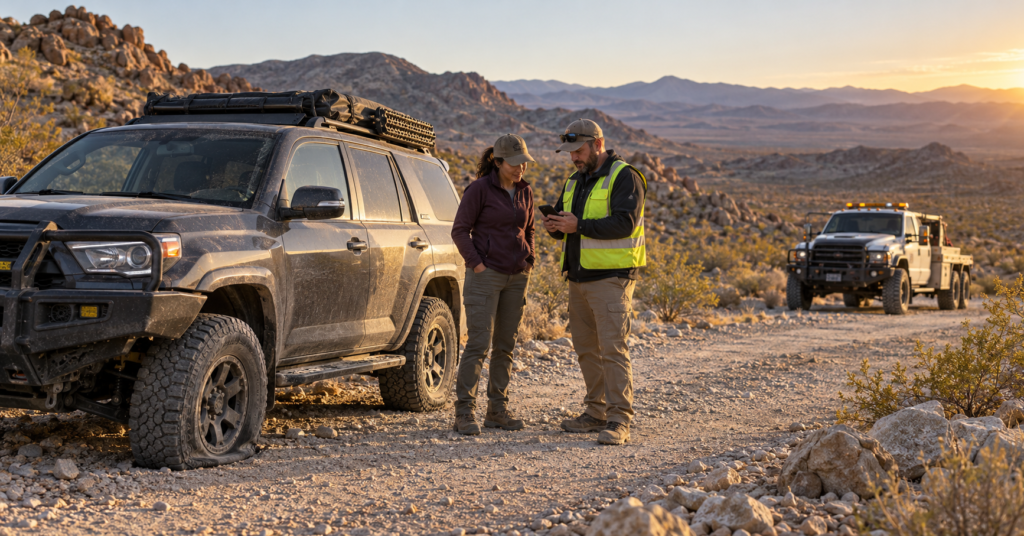
A roadside assistance plan can feel reassuring when packing for a weekend on California’s desert tracks or forest roads. However, a towing allowance does not necessarily cover reaching a vehicle stranded beyond the pavement.
California off-road recovery requires a closer look at where assistance applies, what equipment the job needs, and who pays to move the vehicle to an accessible pickup point. These questions matter whether you are planning an overnight overlanding trip or a short afternoon on an unpaved route.
Before leaving, work out how your assistance arrangements apply to the actual journey—not just how many towing miles appear on your membership card.
Separate Towing From Vehicle Recovery
Towing generally involves transporting a disabled vehicle from a location where a service truck can reach and load it. Recovery may involve freeing that vehicle from sand, moving it off an obstacle, or bringing it along a trail to a suitable loading area.
Consider a truck with a broken suspension several miles along a rocky route. The first job might require specialist equipment to retrieve it. A second truck could then transport it to a repair shop.
Ask whether your assistance plan covers both stages. Specifically, establish whether an extraction charge is separate from the towing allowance and whether a second operator must be arranged.
A generous mileage benefit offers limited reassurance if the initial recovery falls outside the plan.
Check Roadside Assistance Access Rules
The key wording may concern access rather than distance from the nearest town.
For example, AAA Mountain West Group’s terms make winching eligibility dependent on safe access from a passable, normally traveled road or established thoroughfare, using ordinary emergency roadside equipment. The technician assesses whether the vehicle qualifies.
That illustrates why a plan should not be treated as an unrestricted backcountry recovery service. Terms also vary between providers and regional clubs; one member’s experience does not establish another driver’s coverage.
Before traveling, ask:
- Does the plan cover service on the specific unpaved roads you intend to use?
- What restrictions apply to winching, equipment, and labor?
- Can a service truck reach the vehicle without entering difficult terrain?
- Who decides whether the location is eligible?
Keep any written response with the applicable membership terms. A general reassurance over the phone may leave important conditions unresolved.
Legal Trail Access Does Not Establish Service Eligibility
A road can be legally open to your vehicle without being suitable for a conventional tow truck. Narrow switchbacks, soft shoulders, steep grades, or limited turning space may prevent access.
Give the assistance provider a road name or route number rather than describing the destination simply as “near a campground.” Where possible, identify the land manager, nearest paved junction, and expected distance along the unpaved section.
For broader route selection and camping preparation, TCG’s California overlanding guide explains how to check public-land access before a trip.
Keep the two decisions separate: permission to drive the route and arrangements for retrieving a disabled vehicle.
Confirm Eligibility for Your Loaded Vehicle
The vehicle used for everyday commuting may have very different recovery requirements once packed for an overlanding trip.
When asking about assistance, describe the actual setup: vehicle model, approximate loaded weight, modifications, camper, and any trailer. Ask whether those details affect eligibility or the equipment needed.
A tow vehicle and its trailer also create separate transport questions. If the truck breaks down, establish whether the trailer can travel with it, requires another operator, or needs temporary storage.
Passenger arrangements deserve attention too. Ask how everyone would leave the location if the recovery vehicle cannot accommodate the whole group, including children or pets.
Ask for an Itemized Remote-Recovery Estimate
There is no useful single price for California off-road recovery. Location, terrain, vehicle condition, and the equipment required can change the scope substantially.
The National Park Service warns that recovering a stuck vehicle in Death Valley can cost thousands of dollars. That is a reason to plan for a significant expense, rather than assume a routine local towing charge.
Before authorizing a non-emergency commercial recovery, ask the operator to explain:
- Travel or dispatch charges and when billing starts.
- Minimum labor time and additional crew costs.
- Specialist equipment or extra service vehicles.
- Transport destination and any storage charges.
- Charges if access proves impossible or the job must be postponed.
Request an estimate in writing when communication allows. If conditions make a fixed price impractical, ask how additional work will be authorized and documented.
Establish Reimbursement Requirements Before Hiring Help
An operator’s ability to recover the vehicle does not establish that your membership or insurer will reimburse the invoice.
Ask the organization responsible for your benefit whether you must contact its dispatch service first, obtain authorization, or use an approved operator. Confirm any reimbursement limit and submission deadline.
If you arrange assistance independently, retain the request number, authorization messages, itemized invoice, and proof of payment. Record the reason an outside operator was needed.
Also distinguish roadside assistance from vehicle-damage insurance. Ask separately about the recovery expense and any damage to the vehicle; do not assume approval of one settles the other.
Prepare a Location Report Before Losing Signal
A useful recovery request explains both where the vehicle is and why it cannot move.
Save your route offline and make sure you can read out coordinates. Include the coordinate format so the recipient can interpret them correctly.
Useful details include the road number, last junction passed, direction of travel, vehicle description, and whether the wheels can roll or steer. Photographs taken from a safe position can help an operator assess surrounding terrain and access.
Explain obstacles between the vehicle and pavement, including gates, washouts, or narrow sections. A nearby road visible on a map may not connect to your location.
Do not move into hazardous terrain merely to obtain a better photograph or phone signal.
Make a Communication Plan for More Than Emergencies
A satellite device may provide a way to contact help beyond cellular coverage, but check its actual functions before relying on it. Emergency signaling and ordinary two-way messaging serve different purposes.
Confirm who would receive a non-emergency breakdown message and how that person would contact a recovery operator. Give them your vehicle details, planned route, assistance information, and expected return time.
The National Park Service recommends sharing a clear itinerary and check-in plan with an emergency contact, alongside carrying appropriate communication equipment for remote travel.
Agree on what should happen if you miss a check-in. “Someone knows roughly where we went” is less useful than a route and a specific escalation plan.
Treat Personal Safety and Vehicle Retrieval Separately
An injury, dangerous exposure, or immediate threat requires emergency assistance. Contact 911 where available or use your device’s emergency function, and follow responder instructions.
Getting people to safety does not necessarily resolve how the vehicle will be removed. Commercial recovery may still require separate coordination.
Death Valley’s backcountry guidance warns that rescue can be substantially delayed and advises staying with a broken-down vehicle. Prepare for a prolonged wait with water, food, appropriate clothing, and essential medication. If the immediate location is unsafe, prioritize safety and responder guidance.
Avoid attempting an unfamiliar recovery simply to reduce the bill. Equipment, attachment points, and technique need to suit the situation; owning a strap or winch is not enough.
Save a Recovery Plan With Your Trip Details
Before departure, create a short offline record containing your assistance contact, membership details, relevant access restrictions, route information, and a suitable recovery contact for the area.
Include an accessible handoff location to discuss with an operator, a preferred repair destination, and arrangements for passengers if the vehicle cannot return home that day.
The practical goal is to know who you would contact, what information they need, and which expenses remain uncertain before a breakdown makes those decisions harder.
Note: Assistance terms and service availability can change. The coverage example above comes from the applicable AAA Mountain West Group membership terms; check your own current agreement. For destination-specific preparation, consult the National Park Service’s Death Valley backcountry road guidance.