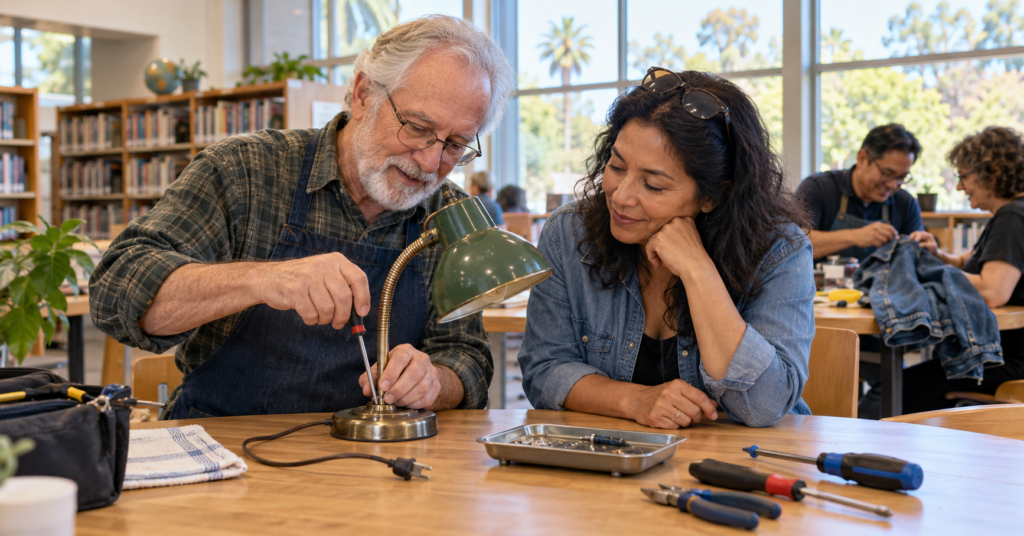
California repair cafés offer a practical reason to reconsider the broken lamp, torn jacket, or small household item sitting in your cupboard. These community events bring people together to explore repairs, share skills, and keep useful belongings in service.
Your first visit will go more smoothly if you choose an event that matches your item and arrive with the information volunteers need. A little preparation can turn a vague request to “fix this” into a productive conversation about what stopped working and what might help.
What Happens at a Community Repair Event
A repair café typically connects visitors with volunteers who have useful repair skills. The experience may involve examining an item together, identifying a fault, attempting a repair, or explaining what further work would require.
The exact format depends on the organizer. Some events include clothing repairs and bicycle help; others concentrate on household appliances or particular practical skills.
For example, a June 2026 Los Angeles Public Library Repair & Fix-It Cafe advertised simple clothing mending, small-appliance repairs, bicycle servicing, basic jewelry repairs, and computer assistance. The listing distinguished mending from clothing alterations and made clear that repairs were not guaranteed.
Treat published examples as evidence of what an event has offered, not a promise that the same services will be available at your next visit.
Find California Repair Cafés Through Local Calendars
Start with your public library, city events calendar, community center, or municipal sustainability department. Search for “repair café,” “fix-it clinic,” or “community repair” alongside your city or county.
Open the full event listing rather than relying on a search-result date. Older announcements can remain online long after an event has ended. Confirm the next session, venue, contact information, and any booking instructions.
Distance is only one consideration. A nearby event focused on sewing may be a better choice for a damaged jacket than a larger gathering across town with no textile volunteers.
If the listing is unclear, send a short inquiry describing your item and the problem. Include the make and model where relevant, plus a photograph if the organizer accepts one.
Check Accepted Items Before Packing
Choose one priority item for your first visit. It will be easier to transport, explain, and keep track of while you learn how the event operates.
Ask whether the organizer accepts that type of item, whether there are size limits, and whether the relevant repair skill will be available. Do not assume that “household repairs” includes every appliance, piece of furniture, or electronic device.
Item limits also differ. Sunnyvale Public Library’s May 2026 repair café listing allowed two items per household. The Los Angeles event described above started with one item per person, with another session possible after the first repair was finished.
These examples show why the particular event’s instructions matter. Arriving with several boxes can create difficulties for both you and the volunteers.
Prepare a Clear Description of the Problem
Write a brief account of what happens when you use the item. Useful details include when the problem started, whether it happens every time, and whether anything changed immediately beforehand.
For a jacket, identify the damaged seam or fastening. For a household device, describe the symptom without guessing at the cause. “The switch clicks but nothing happens” gives a volunteer more to work with than “the motor is broken.”
Mention previous repair attempts and keep any removed components together. If the fault happens intermittently, an existing photograph or video may help explain it.
Avoid dismantling an unfamiliar item just to make it look ready for repair. Ask the organizer how it should be presented.
Bring Accessories and Confirm Replacement Parts
Think about what is needed to assess the item, not simply the main object. An approved power adapter, detachable component, instruction manual, or model number may be useful.
Some organizers expect visitors to supply replacement parts. Glendale’s published repair-event guidance, for example, asks participants to bring needed parts and items that allow the repair to be tested.
That does not mean you should order a component based on a guess. If you do not know which part is needed, ask whether volunteers can assess the problem during the first visit and advise on a later return.
Check compatibility before purchasing anything. Similar-looking fasteners, fittings, or electrical components may not be interchangeable. Keep receipts and packaging until you know the part is suitable.
Plan for Queues, Check-In, and Accessibility
An event’s finishing time may be later than its final repair intake. Sunnyvale’s May 2026 session, for example, ran until 2:30 p.m. but stopped accepting new fixes at 2 p.m. It also operated without advance registration, on a first-come basis.
Check whether your chosen event uses appointments, a sign-in queue, or separate stations. Allow time for assessment and waiting rather than planning a brief drop-off between other errands.
If you need step-free access, seating, communication support, or help carrying an item, contact the venue in advance. Explain the practical accommodation you need and ask what arrangements are available.
Plan the journey home too. Bring a container for loose parts and enough carrying space to return with the item even if it remains unrepaired.
Understand Free Help and Possible Expenses
Free entry or volunteer assistance does not necessarily cover replacement parts, travel, parking, or work that requires a separate professional service.
Before spending money, decide what a successful repair is worth to you. A modest parts cost may make sense for a sturdy item you use regularly. An uncertain repair requiring several journeys may deserve a different decision.
Sentimental value matters too. If an item is irreplaceable, tell the volunteer before work begins and discuss whether a specialist would be more appropriate.
Read the event’s participation conditions. South Pasadena’s official repair-café announcement, for instance, explained that service availability and successful repair were not guaranteed and that visitors needed to provide replacement parts when required.
Take Part in the Repair Conversation
Ask whether you should stay with your item and how you can participate. You do not need technical knowledge to explain its history, hold a component when invited, or take notes.
Useful questions include what caused the problem, what was changed, and whether any maintenance could reduce the chance of it happening again.
Let volunteers explain their proposed approach before they proceed, particularly if it would alter the item’s appearance. With clothing, discuss whether a visible patch is acceptable. With other belongings, clarify which cosmetic marks matter to you.
Respect the volunteer’s decision to stop or refer the task elsewhere. A careful assessment can still be valuable when a repair cannot be completed at the event.
Leave With a Clear Next Step
Before packing up, ask what was completed and whether anything remains unresolved. Record any recommended part specifications or follow-up arrangements while the details are fresh.
If the item is still unusable, decide whether to seek a professional quote, return to a suitable future session, or investigate an appropriate local disposal option. Do not leave it at the venue unless the organizer explicitly accepts donations or discarded items.
Keep any repair notes with the product information. They can help explain the history if another problem develops later.
Make Repair Part of Your Local Routine
California repair cafés can make everyday maintenance a shared activity rather than another task postponed at home. Returning to the same event also gives you a chance to recognize volunteers and learn which skills are available locally.
For more ways to find welcoming places outside home and work, read our guide to California third places and building community on a budget. A repair event can be one practical part of that routine, especially if you enjoy learning through a shared task.
After your first visit, ask how to hear about future sessions. If you want to help, inquire about roles such as welcoming visitors or organizing materials; the coordinator can explain what support is needed.
Note: Event schedules, accepted items, volunteer skills, fees, and participation rules vary. Check the organizer’s current listing before attending. Repair assistance and successful outcomes are not guaranteed.