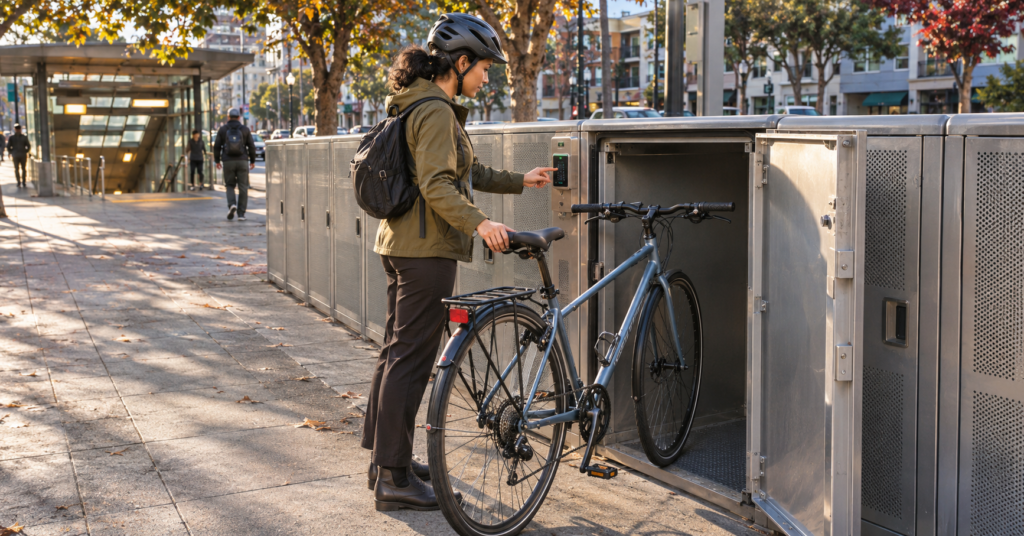
Oakland bike lockers can make a bike-to-BART commute easier by giving you somewhere to leave your bicycle before boarding. However, finding a station with lockers is only the beginning. Your routine also depends on locating an available compartment, using the correct access method, fitting your bicycle inside, and retrieving it when you return.
A short practice visit can reveal these details before they interfere with work or an appointment. Build your first commute around the entire journey—from your front door to the platform—and leave enough flexibility to handle an occupied locker or unfamiliar entrance.
Understand Oakland Bike Lockers and Other Parking Options
BART offers several forms of bicycle parking. Individual lockers, shared self-park facilities, attended bike stations, and open racks have different access arrangements.
For example, BART lists attended parking at 19th Street Oakland and Fruitvale, while MacArthur has a self-park bike station. These facilities are separate from individual lockers.
Before choosing a location, identify the actual parking type you intend to use. A photograph of a bicycle facility does not establish whether it has individual compartments, staff assistance, or unrestricted retrieval hours.
Ask about operating hours when considering attended parking. Your morning arrival may fit comfortably within the schedule while a late return does not.
Check the Current Locker Location Before Riding
Station entrances and bicycle parking areas are not always beside one another. Identify the locker location and the walking route from it to the fare gates.
Construction can also change a familiar approach. BART’s September 2026 West Oakland notice moved bicycle parking from the station’s south side toward the north side along 7th Street. It identifies locker areas near the station’s northeast corner and inside the parking lot west of the main pedestrian entrance from 7th Street.
Check station-specific notices before relying on an older map or photograph. A general station listing may not explain a temporary detour.
During a practice visit, note the entrance you will use after parking. Include crossings and the walk to the platform when estimating your departure time.
Set Up Your Locker Access Before the First Commute
BART’s on-demand lockers accept a BikeLink card or the BikeLink mobile app. App users can establish an account and load funds before arriving.
Complete the setup at home, where you can review instructions without watching a train departure countdown. Confirm that you can sign in and identify the parking location you plan to use.
For app access, start with a charged phone. Keep the relevant support details somewhere you can reach if your usual device becomes unavailable.
Practice Opening and Ending a Rental
Try a short parking session when you are not rushing. Follow the equipment’s instructions through the complete process, including retrieving the bicycle and ending the session.
This makes it easier to recognize a successful transaction later. It also gives you an opportunity to ask for help before leaving your bicycle for an entire workday.
Test Bicycle Fit With Your Normal Accessories
Bring the bicycle you actually commute on, including its basket, rack, panniers, or child seat. Measuring only the frame length can overlook the parts that make parking awkward.
Check whether you can:
- Move the bicycle through the opening without force.
- Position the handlebars and pedals comfortably.
- Close the door without pressing against accessories.
- Retrieve the bicycle without lifting more weight than you can manage.
An extended cargo bike, unusually wide handlebar, or large rear attachment deserves an advance fit check. Ask about the specific locker’s dimensions rather than assuming all compartments are identical.
Do not force a door closed against the bicycle. Find an appropriate alternative when the equipment cannot accommodate your setup.
Budget for Parking Time and Delayed Returns
BART currently lists its electronic locker rate as five cents per hour. At that rate, a ten-hour session costs 50 cents. Its guidance also states that unused time and value are refunded when the rental ends.
Estimate the full time away from the bicycle, including the trip to work, your shift, and the return journey. Add realistic flexibility for an errand or delayed train.
Review the maximum rental duration displayed at your chosen location before committing to overnight or extended parking. A locker suitable for a workday should not automatically become storage for a weekend trip.
Keep parking expenses separate from fares and bicycle maintenance when comparing commuting costs. Our guide to living in California without a car explains how cycling and public transportation can fit into a broader household travel plan.
Prepare for an Occupied Locker
BART’s on-demand lockers are shared and available on a first-come, first-served basis. Having a working account does not reserve a compartment.
Choose a fallback before your first commute. Depending on your route, that could mean another bicycle parking facility, a suitable rack, or returning home and using a different connection.
Carry an appropriate lock if rack parking is part of that backup plan. BART recommends a good-quality U-lock and warns that cable locks are easily cut.
Avoid improvising by attaching the bicycle to a railing, gate, or other structure that could obstruct access.
Check Train Rules Before Using Onboard Space as Backup
Taking your bicycle onto BART may be an alternative, but it comes with its own restrictions. BART prohibits bicycles in the first car and in any crowded car.
That means an occupied locker does not guarantee you can board the next train with your bicycle. Consider whether you could wait for a less crowded service without missing your commitment.
Also plan the destination end of the journey. Bringing the bicycle aboard helps only if you can manage the station exit, reach your destination, and park there.
Make Retrieval Part of Your Evening Routine
Photograph the locker identifier or save its location after parking. Nearby compartments can look similar, particularly when you return after dark.
Before leaving the station area, confirm that you have ended the rental correctly and collected your belongings. Check that your lights and other riding equipment are ready for the trip home.
Keep a separate record of your bicycle’s serial number, description, and photographs. BART recommends recording identifying information because it can assist recovery if a bicycle is stolen.
For autumn and winter commuting, test the return route during the hours you expect to travel. A comfortable morning ride can feel different after sunset, especially around unfamiliar crossings or construction.
Frequently Asked Questions
Can I reserve an Oakland bike locker for every weekday?
Do not build your routine around an assumed personal allocation. The on-demand system serves shared use, so identify a backup that still gets you to your destination on time.
Is a bike station the same as an individual locker?
No. A bike station may provide attended parking or shared self-service space. An individual locker encloses a bicycle in a separate compartment. Check the access and retrieval arrangements for the facility you choose.
Should I buy a different bicycle before testing the lockers?
Test your existing bicycle first. Accessories may affect fit, and a different parking option could be more practical than replacing a bicycle that otherwise suits your commute.
What should I do if the locker will not open when I return?
Follow the support instructions displayed on the equipment or in the access app. Have the location, locker identifier, and rental details ready. Do not force the door or ask another user to manipulate the mechanism.
Can I leave my laptop or work bag with the bicycle?
Take valuables and essential work items with you. Keep your parking routine simple by deciding in advance which accessories stay with the bicycle and which belongings accompany you on the train.
Note: Locker locations, rates, access methods, operating hours, and rental limits can change. Check BART’s current station notices and the instructions at your selected parking facility before your first commute.