San Francisco sandbags can help residents prepare properties for winter rain, but collecting them involves more than finding a distribution location. You need the right address documentation, a way to transport the bags, and a plan for where they will go once you get home.
The most useful time to organize those details is before a storm makes travel difficult. Treat pickup as one part of preparing your household, alongside protecting belongings, monitoring alerts, and keeping access routes clear.
Check Eligibility and the Per-Address Limit
San Francisco Public Works offers residents and businesses up to 10 free sandbags to help protect properties prone to flooding. The program requires proof of a San Francisco address, and supplies are not guaranteed. The City identifies the allowance as a per-address limit.
Coordinate with other people at the property before arranging collection. In a shared house or apartment building, several residents may otherwise make separate plans for the same entrance.
If your building has multiple units, or you are collecting for someone else, ask Public Works how the address requirement applies. Do not assume each occupant qualifies for a separate allocation.
The published instructions require proof of address but do not provide a complete list of acceptable documents. Confirm what to bring if your identification shows an old address or your situation is unusual.
Verify the Pickup Gate and Current Hours
The regular collection point is the Public Works Operations Yard, with entry at the Kansas Street and Marin Street gate. Public Works currently lists year-round pickup hours of Monday through Saturday, 8 a.m. to 2 p.m.
Save the gate location rather than relying only on the facility name. An operations yard can have several access points, and arriving at the wrong entrance adds unnecessary handling and driving.
Check the official instructions again before leaving, particularly around holidays or severe weather. A published operating schedule does not confirm that bags remain available that day.
Plan enough time to reach the entrance, follow staff directions, and load your vehicle before closing.
Treat Neighborhood Giveaways as Date-Specific Events
Public Works also advertises seasonal “Sandbag Saturdays” at neighborhood locations. These can be convenient alternatives to the operations yard, but their dates and sites must be checked for the current season.
Be careful with old social posts, screenshots, and search results. A November announcement may belong to an earlier year even when the location looks familiar.
Before choosing a neighborhood event, verify:
- The year and exact date.
- The collection window.
- The entrance or meeting point.
- Whether any updated notice changes the arrangements.
Share the original City listing with anyone helping you collect. This reduces the chance of one person following an outdated address while another heads to the current site.
Arrange Loading Help Before You Travel
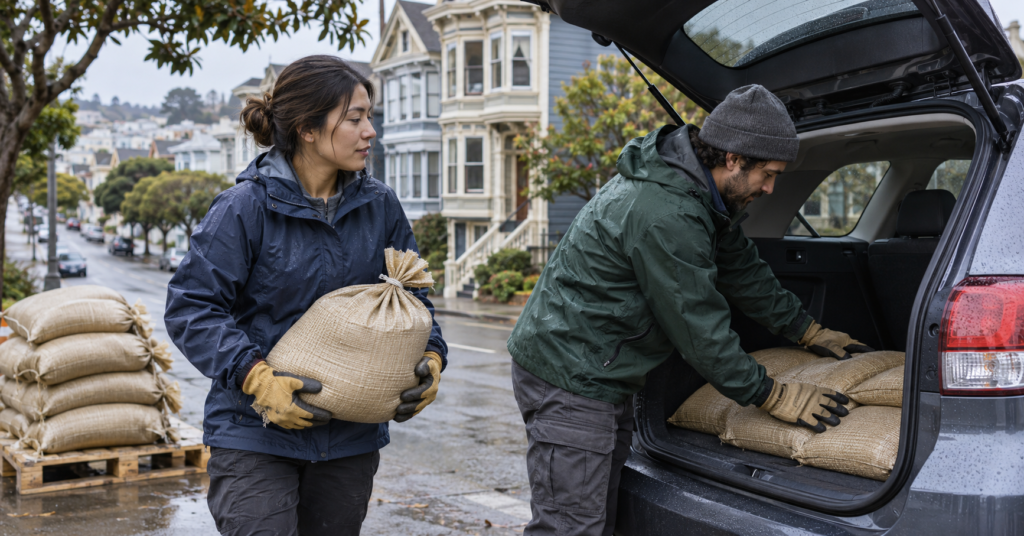
Public Works says members of the public generally need to load the sandbags into their vehicles themselves, with limited exceptions. Do not arrive assuming staff will provide lifting assistance.
If lifting or carrying is difficult, contact the program beforehand to ask what arrangements may be available. Alternatively, organize help from someone who can safely handle the bags.
Think through both ends of the journey. Loading at the collection point is only the first task; unloading beside a steep driveway, narrow passage, or basement stairway may be more demanding.
Clear space in the vehicle before departure. Use a suitable protective liner, secure the load, and check the vehicle’s carrying limits. Include passengers and other cargo when considering the total weight.
Avoid planning a collection that leaves you with bags you cannot safely move from the vehicle.
Decide Where the Sandbags Are Needed
Walk around the property in dry conditions and identify where water has entered previously. Useful observations include a low garage threshold, a sloping entrance, or an exterior stairwell where runoff collects.
Record those locations with photographs and discuss them with the property owner or building manager. Distinguish rainwater approaching an opening from water backing up through plumbing. SFPUC recommends contacting a plumber when flooding or a backup may involve the building’s plumbing or sewer lateral.
Avoid assuming that every water problem can be addressed with bags at a doorway.
California’s Department of Water Resources recommends keeping sandbags, plastic sheeting, and other flood-preparation materials available at flood-prone properties. Its guidance treats preparation as a broader process rather than a single purchase or pickup.
For placement, use official flood-fighting instructions or seek advice appropriate to the property. A small household barrier should not be treated as a guarantee against flooding.
Coordinate Shared Entrances and Escape Routes
In an apartment building, the person collecting sandbags may not be the person responsible for positioning them.
Agree with the landlord, manager, or other residents on who will handle each task. Establish where unused bags will be stored, who will monitor conditions, and who should be contacted if water begins entering.
Keep door operation and access needs central to that discussion. A barrier that complicates wheelchair access, blocks a shared passage, or prevents an exit from opening creates another problem.
Do not improvise arrangements across public sidewalks or neighboring entrances. If the proposed layout would redirect water toward another property or interfere with access, get guidance before proceeding.
A simple photograph of the agreed storage and placement locations can help everyone understand the plan.
Protect Belongings Before the Rain Arrives
Sandbag collection should not delay easier preparations inside the property.
SFPUC advises raising belongings in garages and other low-lying spaces and keeping emergency supplies somewhere safe and elevated.
Start with items that are difficult to replace or move quickly: documents, photographs, work equipment, and stored household supplies. Avoid leaving important possessions in cardboard boxes directly on a garage floor.
Keep a clear route to the items you may need during an outage. Flashlights and charging supplies are less useful if they are buried behind furniture moved during last-minute preparations.
For notification planning, TCG’s guide to California emergency alerts explains how to review registrations and contact details. Check those arrangements while you still have time to correct an outdated phone number or saved address.
Know When to Report Flooding
The City directs residents to 311 for non-life-threatening flooding, blocked drains, sewer backups, and fallen branches. Call 911 for life-threatening emergencies or downed power lines. City guidance also warns against walking, cycling, or driving through floodwater.
When reporting a problem, provide the precise location and describe what you can observe safely. Explain whether water is entering a building or obstructing access.
Do not delay protective action to finish placing bags or obtain photographs. If conditions become dangerous, follow emergency instructions and move away from the hazard.
Having collected supplies does not mean it is safe to remain in a threatened area.
Plan for Storage and Disposal Afterward
Once conditions are safe, distinguish bags that stayed clean from those exposed to floodwater.
San Francisco Environment advises drying sandbags that did not contact floodwater so they can be reused. Bags exposed to floodwater, sewage, or hazardous materials require different handling; potentially contaminated sand should not be emptied into a yard.
Inspect stored bags for tears or deterioration before relying on them during another storm. Keep reusable supplies somewhere accessible without obstructing normal household movement.
Check disposal instructions before placing used bags in a bin. The City’s detailed sandbag-disposal page and its SF Recycles listing currently give different bin directions, so confirm the appropriate method with San Francisco Environment or the collection provider.
Note: Pickup hours, seasonal distribution sites, and available supplies can change. Check the official San Francisco Public Works sandbag page before traveling.