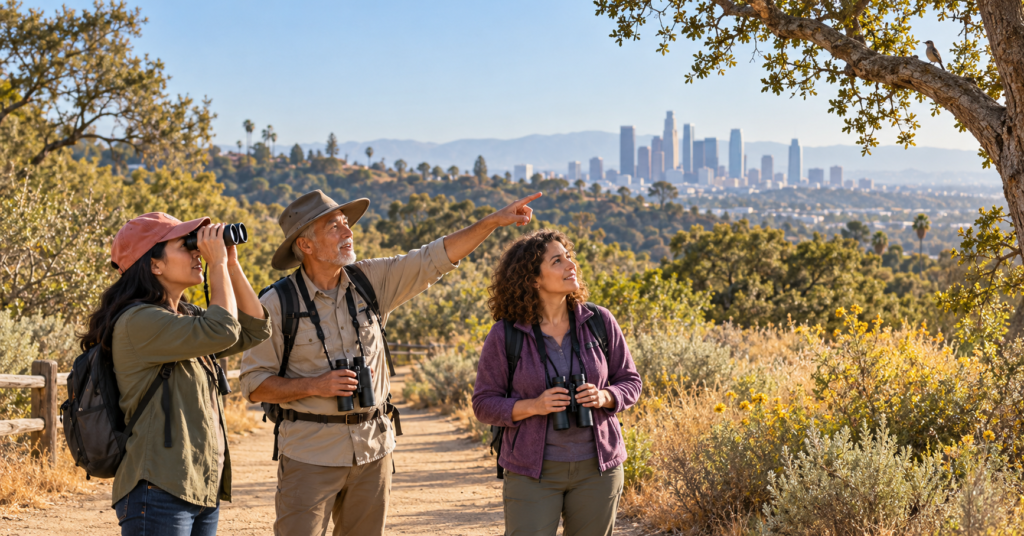
Los Angeles bird walks offer a reason to slow down and notice what lives around the city’s ponds, hillsides, and neighborhood parks. Joining a guided outing can make those first sightings easier to understand, especially when someone can explain where to look and which details matter.
You do not need a long species list or expensive equipment to begin. A suitable group, a manageable route, and a little preparation can make your first morning more enjoyable.
Choose a Beginner Bird Walk That Matches Your Interests
Look for an outing described as introductory, beginner-friendly, or community-focused.
Los Angeles Audubon Society describes its bird walks as suitable for beginner and intermediate birders. Its outings explore settings such as parkland, woodland, coastal scrub, and marshes, with experienced leaders helping participants learn about local birds.
For a first visit, choose somewhere you would enjoy spending time even if sightings are limited. A familiar neighborhood park may feel more approachable than a distant location with complicated access.
Read the individual event description rather than judging by the title alone. Consider whether the outing emphasizes relaxed observation, photography, learning bird calls, or finding particular species. Those interests can produce quite different group experiences.
Confirm the Meeting Point and Arrival Costs
A park address is not always the group’s meeting point. Large recreation areas can have several entrances, parking lots, and trails.
Save the organizer’s directions before leaving. Check whether participants gather at an entrance kiosk, visitor center, lakeside path, or another landmark. Allow time to reach that spot after parking or leaving public transit.
The Kenneth Hahn State Recreation Area bird-walk listing, for example, directs participants to check at the entrance kiosk for the meeting location and identifies a parking charge. It also describes a route through parkland, lake, creek, and coastal scrub habitats.
Check costs separately from the walk itself. An outing without a participation fee may still involve parking or transportation expenses.
If you are inviting friends, share the same event listing and meeting pin with everyone. TCG’s guide to California outdoor meetups offers additional planning ideas for coordinating group arrivals and expectations.
Ask About Terrain, Standing Time, and Accessibility
A slow pace does not necessarily mean an easy route. Birdwatching can involve prolonged standing, uneven surfaces, slopes, and repeated stops.
Before attending, ask about:
- Walking distance and expected duration.
- Surface conditions, steps, and uphill sections.
- Seating, shade, and restroom availability.
- Whether there is a shorter route or an early exit.
At the Audubon Center at Debs Park, the published trail information distinguishes between routes. Its Butterfly Loop is narrow, includes an incline, and is not ADA accessible. The center also describes beginner community bird sits during hot summer months, offering a stationary alternative to a walk.
Explain your practical needs when contacting the organizer. Asking whether a route has benches or firm surfaces produces a more useful answer than simply asking whether it is “easy.”
Check Binocular Loans Before Buying Equipment
Borrowing binoculars can help you discover what feels comfortable before making a purchase.
Los Angeles Audubon says binoculars are provided on many of its walks. The Audubon Center at Debs Park also advertises a free lending library that includes binoculars and other exploration supplies. Confirm availability for your particular visit rather than assuming every participant will receive a pair.
Ask whether equipment must be reserved, shared, or returned at a particular time. Arrive early enough to learn how to adjust the fit and focus.
Practice on a stationary object before the walk begins. Find it with your eyes first, then raise the binoculars while keeping your gaze in place. This is less frustrating than searching randomly through the lenses.
A camera is optional. For your first outing, carrying fewer items may make it easier to listen, watch, and move comfortably.
Read Registration, Child, and Pet Policies
Do not assume that every Los Angeles bird walk follows the same participation rules.
Los Angeles Audubon’s general guidance says its bird walks do not require advance registration and identifies them as appropriate for children aged six and older, with no pets. Still, review the current event notice for any specific instructions.
Venue rules can also differ within one park. Debs Park’s Audubon center excludes dogs from its grounds, while its visitor guidance distinguishes those grounds from surrounding park trails where dogs are allowed.
For children, consider attention span as well as age. A shorter session with one or two memorable sightings may work better than several hours of quiet observation.
If you are bringing a larger group, contact the organizer beforehand. Extra participants can affect equipment availability and the leader’s ability to help everyone.
Pack for a Morning Outdoors
Prepare for the conditions at the actual location, including the temperature expected toward the end of the outing.
Bring drinking water, sun protection, comfortable shoes suitable for the route, and a removable layer. A small snack can be useful if permitted. Keep your hands available by using a light backpack rather than carrying several loose items.
Do not rely on buying supplies at the destination. The Audubon Center at Debs Park, for example, states that it does not sell water or snacks. Its parking guidance also notes limited spaces and a closing gate, making return timing worth checking.
Review organizer updates before departure, particularly when heat, rain, wind, or smoke may affect the outing. Save any cancellation message or revised meeting instructions where you can find them quickly.
Learn How to Follow a Bird Sighting
When someone points out a bird, start with the larger landmark they describe: a particular tree, reed bed, fence, or branch.
Ask for a more precise location if you cannot find it. “Near the trunk or toward the branch tip?” is easier to answer than repeatedly saying you cannot see anything.
Once you locate the bird, notice a few features before searching for a name:
- Its approximate size and shape.
- The shape of its bill and tail.
- Distinctive markings or contrasting colors.
- Whether it hops, climbs, swims, or catches insects in flight.
Let the leader explain which clues support the identification. You will learn more from understanding one familiar bird than from trying to memorize every name mentioned.
Missing a brief sighting is normal. Stay with the group instead of rushing ahead to recover it.
Keep Wildlife Watching Quiet and Respectful
Observe birds without trying to force a closer encounter.
The American Birding Association advises particular care around nests, roosts, and feeding areas. Its ethics guidance also calls for restraint when approaching or photographing birds and limiting recordings used to attract them.
For a first group walk, keep bird-call playback off and follow the leader’s directions. If using an identification app, keep its audio from playing aloud.
Stay on permitted paths, respect closed areas, and leave room for other visitors. Never cross onto private property to follow a sighting. Avoid crowding a bird or moving closer simply because someone else has done so.
If a bird repeatedly moves away as you approach, stop advancing. A distant view through binoculars is a better outcome than disturbing the animal for a photograph.
Turn One Outing Into a Local Habit
After the walk, record a few observations while they are fresh. Note the location, habitat, and two or three birds you remember clearly.
Separate confirmed identifications from guesses. A brief note such as “small bird climbing the tree trunk” can be useful even when you do not yet know its name.
For your next outing, consider returning to the same place. Familiar surroundings let you spend less attention on navigation and more on noticing movement, calls, and behavior.
You can also ask the leader which nearby walk would build on what you learned. That gives you a practical next step without needing to travel across Los Angeles every weekend.
Note: Schedules, equipment loans, access arrangements, and participation rules can change. Check the current Los Angeles Audubon bird-walk listings and the individual venue’s guidance before attending.