A repaired pipe can stop water loss while leaving a household with an unusually expensive bill. California water leak adjustments may reduce some eligible charges, but repairing the problem does not automatically produce a credit.
Eligibility depends on the utility serving the property, the type of leak, and whether the customer meets its application requirements. The resulting relief may also be smaller than expected: an adjustment can reduce the rate charged for qualifying water rather than erase its cost.
Start with the provider named on your bill. Its current policy will determine what evidence to collect, when to apply, and how the request will be assessed.
How California Water Leak Adjustments Work
A leak adjustment is a review of charges associated with a qualifying water loss. It is separate from paying for the repair itself.
For example, Santa Cruz calculates eligible residential relief by charging qualifying leaked water at its lowest applicable tier instead of higher tiers. Water already billed at the lowest tier does not qualify for that rate reduction.
Before estimating potential savings, ask what the program actually adjusts. Does it address water consumption charges, usage-based sewer charges, or both? Does it cover one billing period or several?
Also distinguish a leak adjustment from a billing-error investigation. If you believe a meter reading, service address, or account charge is incorrect, explain that separately. A request based on a repaired leak should accurately describe the water loss that occurred.
Identify the Utility and Account Holder
Use the utility name and account details printed on the bill rather than assuming your city government provides the water. Confirm that the policy you find applies to your provider and customer category.
For renters, the first question is who holds the water account. If a landlord, homeowners association, or property manager receives the utility bill, ask who must submit the request and how any approved credit would appear in your own charges.
Where a separate company allocates a building’s water costs, request the underlying billing period and an explanation of how an adjustment would be passed through.
Keep the property address, account number, and affected service dates together. This helps prevent a request from being associated with the wrong account or period.
Confirm Which Types of Leaks Qualify
The location and source of the leak can matter more than the amount of the bill.
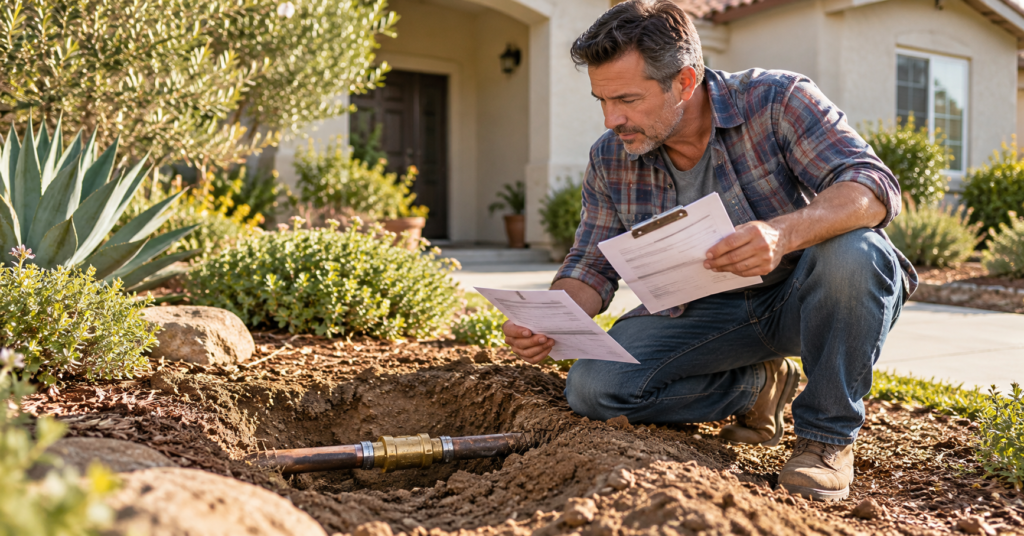
San Diego’s published program covers non-irrigation concealed pipe leaks. It excludes irrigation leaks, swimming pool leaks, and plumbing fixture leaks. LADWP’s program addresses qualifying repaired underground leaks and excludes items such as leaking toilets, faucets, water heaters, sprinklers, and pool equipment.
Ask the person completing the repair to describe the failed component and its location clearly. “Repaired water leak” may leave the reviewer unable to distinguish an underground service pipe from an excluded fixture.
Do not change the description to fit the policy. If the leak falls outside the program, ask whether another billing review or payment arrangement is available.
Find the Application Deadline Immediately
Do not assume the deadline starts when repairs finish. Local policies can measure it from the first high bill or another event.
These published examples show why checking your own provider matters:
| Utility | Published request deadline |
|---|---|
| San Diego | Within 120 days of receiving the first high bill related to the concealed pipe leak |
| San Bruno | Within 30 days of the bill showing increased usage |
| Santa Cruz | Within 30 days after the utility bill date of the first billing cycle containing the leak |
| LADWP | Within 12 months of the occurrence |
These are local examples, not statewide deadlines. Confirm the applicable policy and submission method before relying on a date.
If a repair invoice or other evidence is delayed, contact the utility before the deadline. Ask whether you can open the request and provide additional records afterward, and retain its response. Do not assume an incomplete application preserves eligibility.
Build a Clear Repair Record
Organize the documents so a reviewer can follow what happened without having to reconstruct the event.
A useful file includes the affected bill, the discovery date, the repair date, photographs where available, and an invoice explaining the work. San Diego specifically requests discovery and repair dates plus a repair invoice or receipt. LADWP requests a brief leak description and copies of repair receipts.
Keep discovery and repair dates separate. A problem may be noticed on one day, located later, and permanently fixed after that.
If you completed the repair yourself, ask what substitute documentation is accepted. Parts receipts, dated photographs, and a written explanation may be useful, but the utility decides whether they are sufficient.
Submit records through the approved channel. LADWP, for example, instructs customers not to email the adjustment documents.
Understand How a Bill Credit Is Calculated
A large increase in consumption does not necessarily translate into an equally large credit.
Consider a hypothetical program that reduces eligible leaked water from $12 per billing unit to $8. If ten units qualify, the credit would be $40: ten multiplied by the $4 difference. The customer would still pay the reduced charge for that water.
Those figures illustrate the calculation and are not a quoted utility rate.
Request an explanation showing the eligible leak volume, the original rate, the adjusted rate, and any charges left unchanged. Check whether the calculation uses meter data or compares the affected period with earlier usage.
Avoid treating the entire difference between two bills as leaked water. Changes in occupancy, irrigation, billing-period length, or ordinary household use may also need to be considered.
Ask What Must Be Paid During the Review
Submitting an adjustment request should not be treated as permission to stop paying.
Before the bill becomes overdue, ask the utility what amount remains due, whether a payment arrangement is available, and whether it has placed any hold on collection activity. Request written confirmation of an agreed arrangement.
Keep the adjustment case number separate from any payment-plan reference. This makes follow-up easier if different staff handle the two issues.
If you pay before the review is complete, ask how an approved adjustment would be applied. Confirm whether it would appear as an account credit, reduce a later balance, or be handled another way.
Check Water Usage After the Repair
Review subsequent readings or available account usage data to see whether consumption has returned to its usual pattern.
San Bruno makes a return to historical usage during a full 60-day billing cycle after repair one of its adjustment criteria. Its application deadline is shorter, so customers should not wait for that entire cycle before contacting the city.
If consumption remains unusually high, investigate whether another source of water loss remains. Preserve the follow-up findings rather than assuming the original repair resolved everything.
For a broader household maintenance routine, The California Guide’s California home maintenance guide offers a place to plan recurring checks alongside other property tasks.
Review the Decision and Save the Final Records
When the decision arrives, compare it with the period and repair described in your application. If the utility denies the request, ask for the specific reason and the policy provision it applied.
A missing invoice, an excluded leak type, and a late application are different issues. Ask whether additional evidence or another review is available and whether a further deadline applies.
For an approved request, verify that the stated credit actually appears on the account. Keep the decision, calculation, repair documents, and adjusted bill together.
Record any limit on repeat requests as well. LADWP states that only one underground leak request will be honored within a 24-month period.
Note: Water leak adjustment policies vary by utility and can change. Confirm current eligibility, deadlines, documentation, and payment requirements directly with the provider named on your bill.