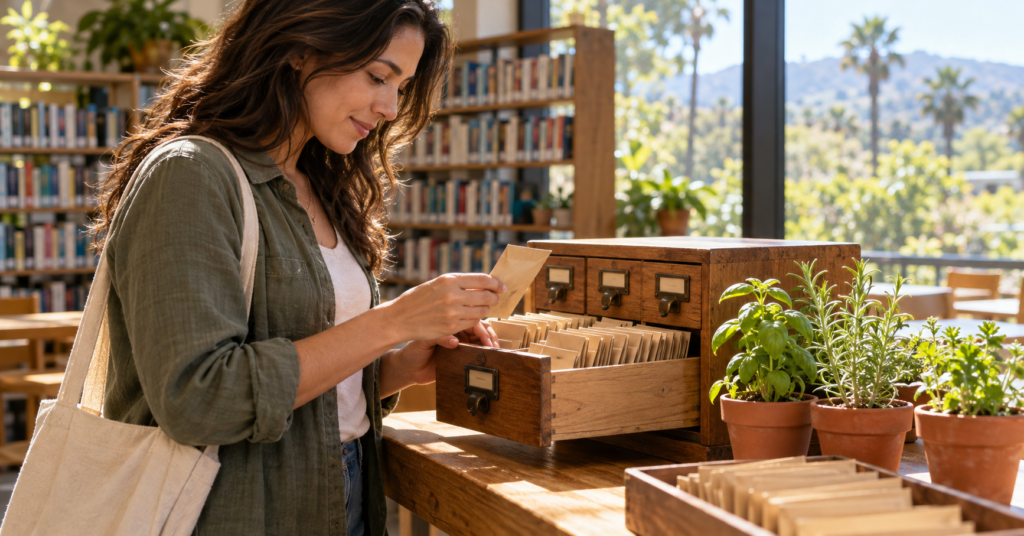
California seed libraries offer a simple way to try gardening without buying a full selection of seed packets. Depending on the location, you may find vegetables, herbs, or flowers for a backyard bed or a few containers outside your home.
The best first visit starts with knowing what you can realistically grow. Your available sunlight, planting season, and space matter more than how many varieties are in the cabinet. Choosing a small, suitable selection also makes it easier to learn how each plant develops.
Before collecting seeds, check the local program’s rules and prepare a place to plant them. These first-garden tips will help you turn a library visit into a manageable growing project.
How California Seed Libraries Work
A seed library distributes seeds for people to grow at home. The word “borrow” can be confusing because the original seeds are planted rather than returned like books.
Some programs encourage gardeners to contribute newly harvested seeds later, while others explicitly make participation possible without any return obligation. Union City Library, for example, requires neither a library card nor the saving or return of seeds.
Read the instructions for the branch you intend to visit. Confirm whether you select packets yourself, request them from staff, or place an order for collection.
San Diego Public Library notes that seed varieties, pickup options, and requirements differ by location. Its available stock is limited to what each participating seed library has on hand.
Treat an online seed list as a starting point. Have a second suitable choice in mind if your preferred variety is unavailable.
Check Residency Requirements and Packet Limits
Free access does not always mean the same eligibility rules everywhere.
San Mateo Public Library’s seed program serves San Mateo and Hillsborough residents without requiring a library card. At its Main Library, the published household limit is one packet per seed type and five packets total per visit. Its seasonal branch collections have a smaller limit.
Before making a trip, check the participating branch, current hours, access requirements, and whether limits apply per person or household.
There is no need to take the maximum allowance. For a first attempt, choose two or three varieties that fit your space and that you are interested in growing. A modest selection helps you keep track of planting dates and care needs while leaving seeds for other visitors.
Match Free Seeds to Your Local Planting Season
California does not have one statewide planting calendar. Coastal conditions, inland heat, desert temperatures, and elevation can change when a crop is likely to succeed.
University of California gardening guidance separates vegetables into cool-season and warm-season crops. Lettuce, spinach, and radishes generally belong to the cool-season group, while tomatoes, melons, and squash need warmer conditions. Its regional planting dates are approximate because conditions vary within each region.
Check your county’s UC Master Gardener guidance before sowing. Pay attention to whether a recommended date refers to planting seeds directly outside or setting out seedlings that have already been started.
A packet available today may be intended for a later planting window. Write the appropriate sowing period on your garden plan rather than assuming everything should go into the soil immediately.
Choose Plants for the Sunlight You Actually Have
Observe your growing space before selecting seeds. Note where direct sunlight reaches in the morning and afternoon, and whether buildings, fences, or trees interrupt it.
UC Master Gardener guidance explains that most vegetables need around six to eight hours of direct sun daily. Fruiting crops generally need more sun than leafy crops that can tolerate some partial shade.
A balcony that looks bright indoors may receive only a short period of direct sunlight. Conversely, a sunny paved patio may become much hotter than the surrounding garden.
Use these observations when asking for help choosing varieties. “A container with four hours of morning sun” gives a librarian or gardening volunteer more useful information than “a small outdoor space.”
Plan Container Size Before Bringing Seeds Home
Think about the mature plant, including its roots, spread, and support needs. A small seed can eventually produce a plant that overwhelms a narrow planter.
For container gardening, UC Master Gardeners recommend drainage holes, sufficient root space, and potting mix formulated for containers. Ordinary garden soil or topsoil can compact and is unsuitable as the main growing medium in a pot.
Use this quick planning table before choosing your packets:
| Growing situation | What to check |
|---|---|
| Shallow planter | Whether the crop’s mature roots have enough depth |
| Small balcony | Plant spread, support needs, and clear walking space |
| Hot patio | Exposure to afternoon heat and access to water |
| Shared outdoor area | Permission to place containers and manage drainage |
| Limited gardening time | Whether the planned number of pots is manageable |
For rented or shared spaces, settle placement questions first. Consider where water will drain and how you will reach every container without moving heavy pots.
Read Seed Labels Before Sowing
Keep the packet or photograph its label. Useful details include the plant name, variety, sowing depth, spacing, expected germination time, and any special preparation.
If a donated packet has only a general description, ask for more information before planting. Knowing the variety can help you anticipate plant size and growing requirements.
UC’s Alameda County seed-planting guidance recommends following crop-specific spacing instructions and sowing at an appropriate depth. It also explains that seedlings may need thinning after emergence to reach the recommended spacing.
Label each pot when you sow it. Record the variety and date rather than relying on memory or trying to identify similar seedlings later.
Do not assume every flower or vegetable follows the same method. Follow instructions for that particular seed, especially if the packet mentions a treatment before planting.
Establish a Small, Repeatable Care Routine
Before sowing, decide when you can check the containers and how you will water them. Keep the initial setup close enough to observe easily.
Container material and exposure affect moisture loss. Porous clay pots can dry faster, while hot surfaces and strong sun can increase the attention a planting needs. UC guidance also cautions that container roots are vulnerable to temperature extremes.
Check conditions rather than watering automatically on a fixed schedule. Follow the growing instructions for your chosen plants and seek local advice if the soil stays wet or seedlings repeatedly wilt.
Keep brief notes on emergence, weather, and any changes you make. If a planting struggles, those observations are more useful than immediately replacing every seed or changing several things at once.
Save Seeds Only When You Understand the Crop
Seed saving can be a later project rather than a requirement for your first garden.
UC Master Gardeners recommend selecting healthy plants and understanding their pollination habits. Seeds from hybrid varieties may produce plants that differ from the parent, while cross-pollination can also affect the next generation. Seeds must mature properly before collection, sometimes beyond the stage when a vegetable would normally be harvested for eating.
Ask the library about its donation policy before setting seeds aside. San Mateo, for example, requests clean, dry, open-pollinated or heirloom seeds and does not accept seeds harvested from grocery-store produce.
Keep any collected seeds clearly labeled with the plant, variety if known, and collection date. Store them under cool, dry conditions while following crop-specific guidance.
Use Library Gardening Events to Build Your Skills
The seed cabinet may be only one part of the program. San Diego’s participating libraries also offer gardening, composting, and related workshops.
Bring focused questions to an event: whether your planting date suits the local climate, why a particular seedling looks weak, or which variety fits your container. Photographs and planting notes can make the conversation more useful.
For your next visit, let the first planting guide your choices. You might repeat a successful herb, try a different seasonal crop, or reduce the number of pots to fit your routine. Each small experiment can help you build a garden that suits your home.
Note: California seed libraries set their own eligibility, packet limits, availability, and donation rules. Check the participating branch’s current guidance and use local planting advice for your climate.