California tool libraries can help residents complete occasional projects without buying equipment they may rarely use again. Borrowing can also make sense when storage is limited, particularly for renters and people living in smaller homes.
The useful part is access to equipment. The part that needs planning is the borrowing agreement. Eligibility, reservations, return locations, and responsibility for missing accessories can differ between library systems.
Before arranging a weekend project around a borrowed tool, confirm that you qualify, that the equipment suits the task, and that you can return it on time. A little preparation makes the service easier to use and helps avoid unexpected charges.
Find the Right Tool Lending Collection
Start with your city or county library’s website and search for “tool lending,” “Library of Things,” or “special collections.” A tool collection may have its own registration process and pickup location rather than operating through every neighborhood branch.
Browse the actual inventory before planning your project. Berkeley Public Library, for example, lists carpentry and woodworking equipment such as hammers, levels, cabinet jacks, and miter boxes. Other collections may concentrate on gardening, household equipment, or craft supplies.
Search for the specific item you need rather than assuming every tool library carries the same selection. Read the description for its dimensions, included attachments, and intended use.
For a first visit, choose a manageable task with a flexible deadline. That gives you time to understand the checkout process before relying on borrowed equipment for a larger project.
Check Library Card and Residency Requirements
A regular library card does not necessarily provide access to every special collection.
Berkeley’s tool borrowing rules restrict eligibility to Berkeley residents or property owners over age 18. Borrowers must register with the tool library and provide accepted documentation verifying their address or property ownership.
Butte County takes a different approach. Its Library of Things requires borrowers to be at least 18, show photo identification, and hold a full-access library card with an account in good standing. Certain limited-access cards, including eCards, are not eligible.
Check these requirements before traveling. If you recently moved, ask which address documents the library accepts and whether your account needs updating.
Also confirm whether first-time registration happens at the main circulation desk or at a separate tool counter. Allow enough time to complete it before the service closes.
Understand Holds and Availability Before Setting a Date
Reservation systems vary across California tool libraries.
LA County Library does not allow advance reservations or online catalog holds for its tool collection. If an item is available, borrowers may telephone the participating branch to request a same-day hold. Butte County allows holds on its Library of Things items, although collection remains at the Oroville Branch.
This distinction matters when coordinating transportation, supplies, or help with a project. An item appearing in the collection does not mean it will be available on the weekend you prefer.
Wait for the library’s pickup confirmation before making arrangements that depend on the equipment. If you need several items, check each one separately.
For a project with a fixed deadline, decide in advance what you will do if the tool is unavailable. Postponing the task may be more sensible than buying an expensive substitute at the last minute.
Build the Loan Period Into Your Project Schedule
The checkout period needs to cover collection, preparation, use, cleaning, and the return trip.
LA County’s tool loans currently last seven days without renewals. Butte County’s Library of Things offers 21-day loans, also without renewals. These are local examples, not statewide standards.
Avoid collecting equipment far ahead of the day you can actually use it. Otherwise, much of the loan may pass while you are still buying materials or clearing a workspace.
Leave a buffer for interruptions. A gardening job might be delayed by weather, while furniture assembly could stop because a required component is missing.
Check the due date on your receipt and add a reminder before it arrives. Do not assume the renewal settings for ordinary books also apply to tools.
Inspect the Tool and Accessories at Pickup
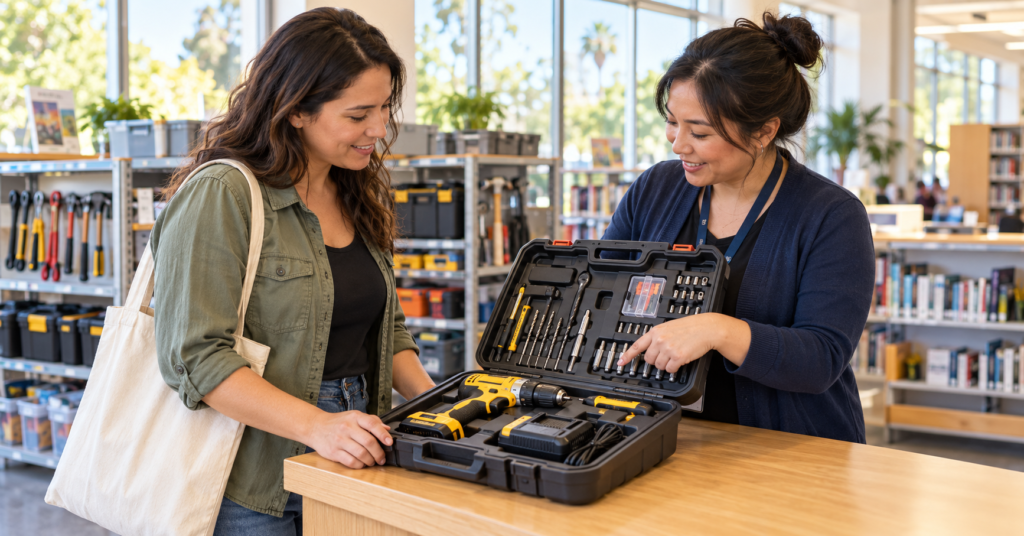
Before leaving, compare the equipment with its inventory list or case layout. Ask staff to record anything missing or visibly damaged.
A quick check can include:
| Item to review | What to look for |
|---|---|
| Main tool | Visible damage, loose components, or missing guards |
| Power equipment | Included battery, charger, and power cord, where applicable |
| Attachments | Listed bits, nozzles, guides, or other accessories |
| Carrying case | Compartments and supplied storage pieces |
| Instructions | The manual for the model being borrowed |
Keep small accessories together throughout the loan. A separate tray or container in your workspace can prevent borrowed components from becoming mixed with your own supplies.
If something looks unsafe, ask for another item or postpone the task. Do not attempt to repair, modify, or bypass a problem on borrowed equipment.
Read the Borrower Agreement Before Sharing Equipment
Tool borrowing may involve restrictions beyond returning the item.
LA County Library requires a signed waiver and permits only the borrower to use its loaned equipment. Its agreement also explains that staff cannot provide operating assistance beyond the manufacturer’s instructions.
Read your own library’s terms before borrowing something for a friend, neighbor, or group project. The person checking out the tool may remain responsible even when someone else wants to use it.
Separate access to equipment from readiness to do the work. Read the manual and establish whether you have the experience, workspace, and protective equipment the task requires.
For household planning, our guide to California home maintenance can help identify routine tasks and work better assessed by a qualified professional.
Budget for Supplies and Possible Replacement Charges
Borrowing the main tool may still leave you with project expenses. Ask which consumable supplies are included and which you must provide.
Depending on the equipment, this could mean purchasing suitable sandpaper, thread, fasteners, or other materials. Confirm compatibility before buying them.
Also ask how the library handles missing components and damage. Butte County states that borrowers may be responsible for repair or replacement costs for the item and its accessories, and its replacement-cost list is available on request.
A useful comparison includes transportation, supplies, and the time needed for pickup and return. Borrowing a bulky item from a distant branch may offer less practical value than borrowing a small tool nearby.
Keep the checkout receipt until the loan is fully cleared from your account.
Plan the Return Trip Before You Borrow
Special equipment often has different return arrangements from books. LA County requires tools to be returned to the lending branch during open hours and prohibits placing them in a book drop.
Check the return counter’s hours before selecting a pickup date. Make sure you can transport the item back, particularly if you relied on another person’s vehicle to collect it.
Follow the library’s cleaning instructions, gather every accessory, and report any fault you noticed during use. Returning equipment early when you finish also gives staff time to prepare it for the next borrower.
Before leaving the counter, ask whether the return is complete or whether staff need additional time to inspect the kit. Check your account afterward so an unresolved item does not go unnoticed.
Note: Tool inventories, eligibility rules, fees, and borrowing periods vary by library and may change. Confirm the current terms with the lending location and follow the equipment manufacturer’s instructions.