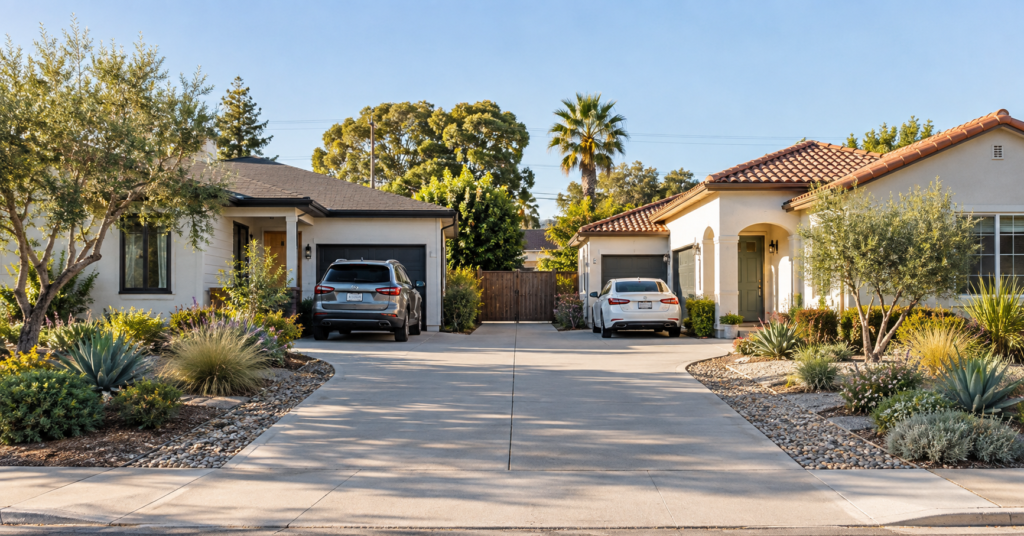
A shared driveway can make two neighboring homes accessible without requiring separate entrances from the street. It may also create disagreements over parking, maintenance, deliveries and repair costs when ownership and usage rules are unclear.
California Shared Driveways deserve careful review before a buyer removes contingencies. The paved area visible during a showing may cross several parcels, follow an easement or include land that does not belong to the home being sold.
Buyers should examine both the recorded documents and the physical condition of the driveway. A legal right to use the route does not guarantee that the surface is in good condition or that neighbors agree about how it should be managed.
What Makes a Driveway Shared?
A driveway is shared when more than one property depends on the same route for vehicle or pedestrian access. The arrangement can take several forms.
One owner may possess the land while a neighboring parcel has an easement allowing passage over it. Two properties may each own part of the paved area while granting access rights to one another. A private road may also serve several homes without belonging entirely to any individual resident.
The physical appearance does not establish the legal arrangement. A wide driveway may sit completely within one parcel, while a narrow strip that looks private may be subject to several recorded access rights.
Understanding who owns the land and who may use it is the first essential check.
Locate the Recorded Easement
A seller or real estate agent may describe the driveway as “shared by agreement,” but a buyer should locate the document creating that right.
An express easement may appear in a deed, subdivision map, separate agreement or other recorded instrument. The title report may list the document by recording number without reproducing every condition.
The buyer should request the complete document and confirm which properties benefit from it. The description should also identify the land burdened by the easement and the permitted type of use.
A recorded access right is generally more dependable than a casual arrangement between current neighbors. A friendly understanding may disappear when either property is sold.
Compare the Document With the Actual Driveway
Legal descriptions can be difficult to compare with what is visible on the property. The paved surface may not follow the recorded easement exactly.
A driveway might have been widened, relocated or extended over time. Landscaping, retaining walls and fences can also make its current route different from an older map.
A survey professional can help locate parcel boundaries and easement areas. This becomes especially important when garages, gates or parking pads sit close to the boundary.
Buyers should not rely only on online parcel maps. Those maps are useful for general reference but may not be precise enough to settle a boundary or access question.
Identify the Easement’s Permitted Uses
An access easement does not necessarily allow every possible use of the driveway. Its language may authorize vehicle passage while saying nothing about parking, storage or construction activity.
A buyer should determine whether the easement permits:
- Vehicle and pedestrian access
- Guest and delivery access
- Construction and maintenance vehicles
- Utility installation or repair
- Emergency vehicle access
- Temporary stopping or loading
The width and purpose stated in the document can matter. A right to pass over the driveway may not include a right to leave vehicles there.
If the property will be remodeled, used for regular deliveries or occupied by several drivers, the permitted use deserves particular attention.
Check Whether Parking Is Allowed
Parking is one of the most common sources of shared-driveway conflict. Even briefly stopping in the wrong place can prevent a neighbor from reaching a garage or entering the street safely.
The buyer should observe whether vehicles, trash containers, trailers or recreational equipment are regularly placed within the access route. Existing behavior may reveal how the space is actually treated.
Recorded documents, CC&Rs or private agreements may prohibit parking within the shared area. Local fire-access rules can impose additional restrictions.
A buyer who expects to use part of the driveway as extra parking should confirm that the property includes that area and that doing so will not interfere with another owner’s rights.
Understand Maintenance Responsibilities
A recorded easement may contain detailed maintenance terms, or it may provide access without explaining who must repair the surface.
California Civil Code Section 845 generally addresses maintenance of privately owned rights-of-way used by multiple owners. Subject to the specific agreement and circumstances, repair costs may be shared according to the nature and extent of each owner’s use. Buyers can review the current statutory language and obtain legal advice about how it applies.
The buyer should determine who currently arranges routine work and how bills are divided. Maintenance can include more than resurfacing. Drain cleaning, vegetation removal, lighting, gates and retaining structures may also require attention.
A clear written agreement is preferable to relying on neighbors to decide after a failure occurs.
Ask for Previous Repair Records
Past records can show whether the shared arrangement functions smoothly. A buyer may request invoices, estimates, correspondence and evidence of payments for previous repairs.
The documents can reveal whether neighbors contributed as expected or whether one owner has been covering all costs. They may also show repeated damage that is not obvious during a dry-weather visit.
A newly resurfaced driveway should not automatically be considered trouble-free. Buyers should ask who authorized the work, whether all parties paid and whether any warranty can be transferred.
Missing records are not proof of a dispute, but they make future expenses more difficult to predict.
Inspect the Pavement and Base
A home inspection may mention visible cracks, but a shared driveway can require more focused evaluation when its condition is poor.
Long cracks, uneven settlement and crumbling edges may indicate failure below the surface. A thin coating can improve appearance temporarily without correcting an unstable base.
The buyer should note areas where water collects or where vehicle tires repeatedly leave the paved surface. Tight turns and steep grades can accelerate wear, especially when delivery trucks use the route.
Repair cost depends on the driveway’s length, material, drainage and accessibility. Obtaining an estimate before closing can help the buyer understand the possible financial exposure.
Examine Drainage During Wet Conditions
California homes may be viewed during months when little rain falls. A dry driveway can hide drainage problems that become obvious during winter storms.
The buyer should determine where runoff enters and leaves the shared area. Water should not be redirected toward a garage, foundation, neighboring yard or public sidewalk without a suitable drainage path.
Look for stains, sediment, eroded soil and patched pavement near drains. These signs may show where water has previously accumulated.
Drainage structures may serve more than one property, making maintenance responsibility important. A blocked channel on one parcel can create flooding on another.
Buyers evaluating moisture around the building may also find the guide to California home inspections with utilities turned off helpful when normal testing cannot be completed.
Review the Driveway Slope
A steep shared driveway can create daily access problems even when its legal status is clear.
Vehicles may scrape at transitions, lose traction or have difficulty passing one another. Delivery trucks, moving vehicles and emergency equipment may not be able to navigate the same route as a passenger car.
Buyers should test the driveway with the type of vehicle they expect to use, with the seller’s permission. The approach should be checked in both directions because visibility and turning space may differ when leaving.
Slope also affects runoff speed. Water moving rapidly downhill can damage pavement edges and concentrate erosion near the lower property.
Look for Retaining Walls and Hillside Support
Shared driveways on sloped properties may depend on retaining walls, embankments or engineered supports. Failure of one component can limit access to several homes.
The buyer should identify which parcel contains each structure and whether the easement agreement addresses repair. A wall may physically support the driveway even though it belongs to a neighboring property.
Cracks, leaning sections, drainage stains and soil movement deserve further evaluation. An ordinary visual inspection may not determine whether a retaining structure is stable.
When the driveway is the home’s only access route, the consequences of a failure can be more significant than the cost of repairing pavement alone.
Check Gates and Access Controls
A gate can provide privacy and security, but it may also restrict another owner’s easement rights.
Buyers should ask who owns the gate, who controls the codes or remotes and who pays for repairs. Emergency access arrangements should also be understood.
A manually operated gate may become difficult for residents with mobility limitations. An automatic gate can stop working during an outage unless it has an appropriate release or backup system.
The easement or private-road agreement may prohibit installing a gate without consent. A buyer who hopes to add one after closing should investigate before assuming approval will be available.
Observe Sightlines at the Street
The point where the driveway meets a public road can create a safety issue. Landscaping, walls, parked vehicles and utility equipment may block a driver’s view.
Shared use increases the possibility of vehicles meeting near the entrance. Buyers should notice whether the driveway is wide enough for passing or whether residents depend on an informal right-of-way pattern.
Backing into a busy road may be difficult if the property lacks a turnaround area. The buyer should also consider morning glare, curves and traffic speed.
A driveway that is legally adequate may still be inconvenient for everyday use.
Verify Fire and Emergency Access
Emergency vehicles require sufficient width, clearance and turning space. A driveway lined with parked cars, low branches or narrow gates may delay access.
Requirements can vary by city, county, fire district and property location. Rural or hillside properties may be subject to different access expectations than homes in an urban subdivision.
The buyer should determine whether the property has received notices concerning fire access or vegetation clearance. Past approval does not guarantee that later modifications remain compliant.
This is especially relevant when the buyer plans to add an ADU, expand the home or change the property’s use.
Investigate Utilities Beneath the Driveway
Shared pavement may cover water, sewer, gas, electrical or communication lines. Utility work can require cutting through the surface.
The buyer should identify any recorded utility easements and ask whether private service lines cross neighboring parcels. An access easement for vehicles does not always resolve rights to repair an underground pipe.
If a sewer or water line fails, management of the excavation and repaving can become complicated. The parties may disagree over who caused the problem or who must restore the driveway.
Known utility locations and previous repair records can help a buyer assess this risk before closing.
Consider Snow, Fire and Rural Conditions
Mountain communities can add snow removal and ice control to the shared-maintenance arrangement. Buyers should ask who plows the driveway, where snow is placed and whether every resident contributes.
In wildfire-prone areas, vegetation management and evacuation access become important. A narrow route serving several homes can become congested if residents attempt to leave at the same time.
Rural private roads may also lack municipal maintenance. Owners could be responsible for grading, drainage, tree removal and storm repairs beyond the driveway immediately beside the home.
The cost and effort of maintaining a long access route should be considered part of owning the property.
Read the Preliminary Title Report Carefully
The preliminary title report may identify easements, covenants and other exceptions affecting the property. Buyers should request copies of every document relevant to driveway access.
The report may also reveal that the property benefits from an easement over another parcel. This is different from an easement allowing neighbors to cross the property being purchased.
Buyers should ask the title or escrow professional which recorded items will remain after closing and what the proposed title policy will cover. Questions requiring legal interpretation should be directed to a qualified California real estate attorney.
The absence of a clearly listed agreement deserves investigation if physical access obviously crosses another parcel.
Ask Whether the Lender Requires an Agreement
A mortgage lender may want reliable legal access to the home. This can become an issue when the driveway crosses private property without a clearly recorded easement.
Some lenders may also review private-road maintenance arrangements, especially when several properties depend on the same route. Requirements vary by loan program and transaction.
The buyer should send relevant title documents to the lender early rather than waiting until final underwriting. A late access concern can delay closing or require new documentation.
Cash buyers should conduct the same review. The next buyer may need financing even if the current purchaser does not.
Review Insurance Implications
The driveway’s ownership and maintenance arrangement may affect how accidents or property damage are handled.
A visitor could fall on an uneven surface, a vehicle could damage a gate or runoff could harm a neighboring structure. The relevant insurance policy may depend on where the incident occurred and who controlled the condition.
Before closing, the buyer can explain the shared arrangement to an insurance professional and ask whether additional information is required. The discussion should include gates, retaining walls and long private access roads when present.
Insurance does not replace a workable maintenance agreement, but it can help the buyer understand potential gaps.
Speak With the Neighbor Carefully
A conversation with the adjoining owner can provide useful practical information. The neighbor may explain how repairs are arranged, where guests park and whether access has caused disagreements.
The discussion should not replace document review. A neighbor’s understanding may differ from what the recorded easement permits.
Buyers can ask neutral questions about routine use rather than attempting to resolve legal issues during an informal conversation. The goal is to understand how the arrangement works from day to day.
If the neighbor describes an ongoing dispute, the buyer should obtain more information before proceeding.
Search for Existing Disputes
A seller may be required to disclose known conflicts affecting the property, but buyers should still conduct their own review.
Relevant warning signs include written complaints, blocked access, unpaid repair invoices and arguments over boundaries. Temporary barriers, surveillance cameras aimed at the driveway or multiple warning signs may also justify questions.
A dispute does not necessarily make the home unsuitable. However, the buyer should understand its subject, status and potential cost.
Promises that the disagreement will disappear after the sale should not substitute for a documented resolution.
Consider Planned Renovations
A future project can increase traffic on a shared driveway. Contractors may need to park, deliver materials or place temporary equipment near the access route.
The buyer should determine whether construction vehicles can reach the property without blocking neighbors. The easement may restrict uses that create unreasonable interference.
Major work could also damage a driveway that was designed for lighter vehicles. The construction contract should address pavement protection and repair.
Buyers planning an addition or ADU should evaluate access alongside zoning, utilities and fire requirements rather than waiting until design is complete.
Include Driveway Questions in the Inspection
A standard home inspection primarily focuses on the house and readily accessible systems. The buyer should confirm how much of the shared driveway the inspector will evaluate.
Additional professionals may be appropriate when the property has serious cracking, drainage problems, retaining structures or uncertain boundaries.
The inspection should document visible conditions rather than deciding legal ownership. A surveyor, title professional or attorney may be needed for those questions.
Buyers completing the purchase from another location may also benefit from the TCG guide to remote California homebuying checks when arranging inspections and document review.
Estimate the Buyer’s Realistic Share of Future Costs
A driveway that appears functional today may need major work within several years. The buyer should estimate the likely cost and determine how it would be divided.
Equal division may not always apply. One owner may use a longer section, operate more vehicles or maintain a separate portion under the recorded agreement.
The calculation should include drainage work, surface preparation and related structures rather than only the visible paving material.
An expected expense does not automatically justify rejecting the property. It should simply be included in the buyer’s ownership budget and negotiations.
Resolve Unclear Terms Before Closing
The period before closing offers the best opportunity to clarify documents, obtain estimates and negotiate solutions.
If no written maintenance agreement exists, the parties may consider whether one should be created and recorded. This requires cooperation from affected owners and appropriate professional guidance.
A buyer should be cautious about accepting vague promises that the paperwork will be handled later. Once the transaction closes, the new owner inherits the practical arrangement and any unresolved uncertainty.
Clear access rights, manageable physical conditions and workable neighbor responsibilities matter more than whether the driveway looks attractive during a showing.
Note: This article provides general educational information and is not legal, surveying, lending, insurance or real estate advice. Easement rights and maintenance duties depend on the recorded documents, property facts and current California law. Buyers should consult qualified professionals before purchasing a home with shared access.