A California Home Inspection becomes significantly less informative when the electricity, water or gas is turned off. The inspector may still examine visible parts of the property, but many systems cannot be operated under normal conditions.
This does not mean the inspection has no value. The roof, foundation, exterior, attic and visible building components may still be reviewed. The problem is that the buyer can leave without knowing whether essential equipment actually works.
Buyers should identify which utilities are unavailable, understand the resulting limitations and decide whether another inspection is needed after service is restored.
Why Utilities May Be Off at a California Property
Utilities can be disconnected for several reasons. The seller may have moved out months earlier and closed the accounts. A lender-owned property may have been winterized or secured after foreclosure.
Homes in probate, long-vacant properties and houses under renovation may also lack active service. In some cases, one utility is available while another is not.
A temporary shutoff can also occur because of a repair, unpaid account, damaged equipment or suspected safety problem. That last possibility deserves particular attention. Buyers should not assume the disconnection was simply an administrative choice.
The reason should be clarified before the inspection date. If the seller cannot explain why a utility is off, the buyer may need additional investigation.
An Inspector May Not Restore Service
A home inspector generally observes and operates systems that are accessible and functioning under normal conditions. Turning on a disconnected utility can create safety, authorization and liability concerns.
An inspector may not know why a breaker is off, why a gas valve is closed or whether plumbing was drained because of a leak. Restoring service without understanding the condition could damage the property or create a hazard.
The person conducting the inspection should not be expected to open a utility account, activate a meter or relight equipment that was intentionally shut down.
Arrangements for service restoration normally need to be made before the appointment by a party with proper authority. The inspector can then determine what is within the agreed inspection scope.
Confirm Utility Status Before Scheduling
Utility availability should be checked when the inspection is being arranged, not when the inspector arrives at the property.
The buyer or buyer’s representative can ask whether electricity, water and gas will be active throughout the inspection. If the home has propane, a private well, solar equipment or another system, its operating status should also be confirmed.
A statement that the utilities are “on” may not be specific enough. The main electrical service might be active while individual breakers remain off. Water may reach the property but be closed at the main valve.
The home should be in a condition that allows its systems to be operated safely and normally. If that will not be possible, the buyer should know before paying for an inspection that cannot cover major functions.
What Can Still Be Inspected
An inspector may still gather useful information without active utilities. Visible structural and exterior components do not always require power, water or gas.
The inspection may include accessible areas of the roof, exterior cladding, grading, drainage, foundation, crawlspace and attic. Doors, windows, stairs, railings and other physical components may also be examined.
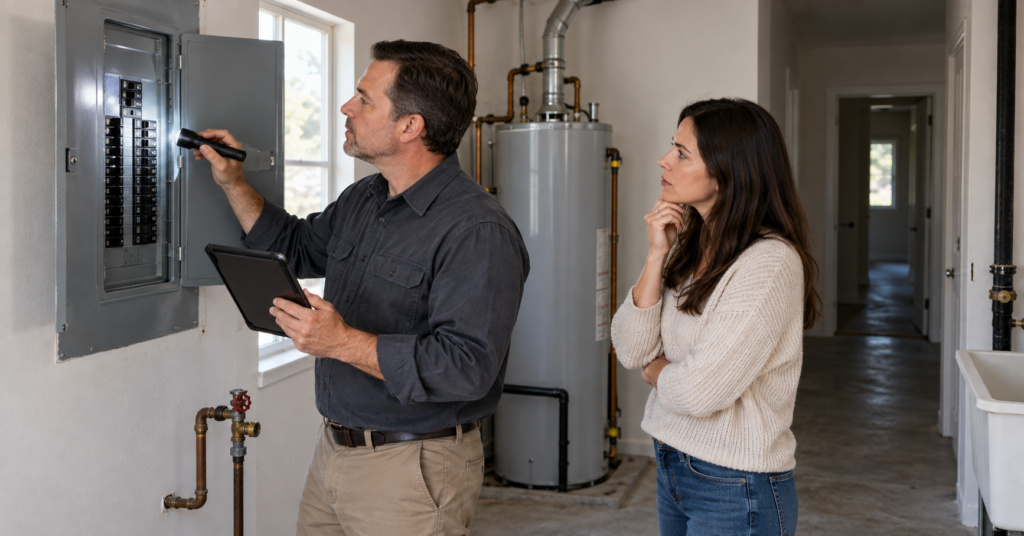
The electrical panel, plumbing materials, water heater, furnace and appliances can be observed for visible defects. However, visual condition does not establish that the equipment operates correctly.
A system can appear clean, recently installed or physically complete and still fail when used. The report should distinguish between components that were inspected visually and those that were functionally tested.
Electrical Service Turned Off
Without electricity, the inspector cannot confirm whether lights, receptacles and many permanently installed systems operate.
Electrical testing may be limited to visible wiring, panels, fixtures and accessible components. The inspector might identify apparent damage, missing covers or unsuitable conditions without being able to determine how the system performs under power.
Receptacles cannot be tested in the usual way when they are not energized. Ground-fault and arc-fault devices may not be fully evaluated. Hardwired smoke alarms, exhaust fans and garage-door openers also remain untested.
The absence of power can hide intermittent problems, overloaded circuits and equipment that trips a breaker during operation.
A panel containing breakers in the off position should not automatically be energized. A breaker may have been switched off because of damaged wiring, incomplete work or faulty equipment.
Heating and Cooling Limitations
Most heating and cooling systems require electricity even when they use natural gas as a fuel. Thermostats, blowers, pumps and control boards cannot function without power.
An inspector may be able to observe the equipment, filters, visible ducts and installation condition. That does not confirm whether the system starts, heats or cools the home.
Air-conditioning equipment also may not be operated under every weather condition. Even with power available, an inspector may avoid running certain systems when outdoor temperatures could damage the equipment.
Buyers should ask what prevented testing. “Not operated because power was off” means something different from “not operated because weather conditions were unsuitable.”
Water Service Turned Off
A visual plumbing inspection cannot replace testing with water flowing through the system.
Without active water service, the inspector cannot evaluate normal pressure at fixtures, run multiple faucets or observe whether drains empty properly. Toilets, showers, tubs and outdoor faucets may remain untested.
Leaks sometimes appear only after pipes are pressurized. A dry cabinet beneath a sink does not prove that the connections will remain dry when the faucet runs.
The water heater also cannot be fully evaluated without a water supply. Operating an empty or partially drained water heater could damage the equipment.
A home that was previously winterized or drained should be restored by an appropriate party before functional plumbing testing occurs.
Drainage Problems May Remain Hidden
Drain pipes can look acceptable from the exterior while containing obstructions, poor slope or damaged sections.
Running water through sinks, tubs and showers helps reveal slow drainage and backups inside the home. Without water, this basic observation is unavailable.
A general home inspection is also different from a dedicated sewer lateral inspection. A sewer camera may require suitable access and enough water to help evaluate the line.
If the property has mature trees, older drain materials or a history of backups, the absence of water should not be treated as evidence that the drainage system is clear.
Gas Service Turned Off
When gas service is unavailable, gas-fired equipment cannot be tested under normal operation. This may affect the furnace, water heater, stove, fireplace, dryer connection or other appliances.
The inspector may observe visible piping, shutoff valves, vents and equipment. Operation, ignition and combustion performance remain unknown.
A closed gas valve should not be opened casually. The service may have been disconnected because of a leak, failed equipment or incomplete repair.
Restoring gas may require coordination with the utility and access to the property. Appliances may also need to be inspected or relit by an appropriate professional.
The buyer should determine why the service is off before treating restoration as a routine task.
Appliances Cannot Be Properly Evaluated
Built-in appliances usually require electricity, water, gas or a combination of services.
A dishwasher needs power, water and drainage. A gas range may use electricity for ignition and controls. A garbage disposal cannot be operated without power, while a washing-machine connection cannot be checked properly without water.
A clean appliance is not necessarily an operational appliance. Recent installation also does not guarantee correct wiring, plumbing or venting.
If an appliance is included in the sale but cannot be tested, the inspection report should identify that limitation clearly. The buyer can then decide whether to request later access for testing.
Private Wells Add More Questions
A property served by a private well may have water available only when the pump has electricity. If power is off, the plumbing and water-supply system may both remain untested.
A well inspection is typically more specialized than a general home inspection. Buyers may need information about the pump, pressure tank, production, water quality and supporting equipment.
The presence of a well does not guarantee that it can provide adequate water for the household. A visual inspection of above-ground components cannot confirm capacity or water quality.
Buyers should determine which tests are appropriate for the property and whether the system can be operated before the inspection contingency expires.
Septic Systems May Need Separate Evaluation
A septic system is not fully evaluated simply by walking around the property. Its condition may depend on the tank, distribution components, drainage area and how the system responds to wastewater.
When the water is off, normal household discharge cannot be observed. The absence of visible sewage or wet ground during a dry inspection provides limited information.
A septic inspection may require access, records and specialized procedures. Buyers should ask whether the system has been pumped, repaired or unused for an extended period.
Utility restoration should be coordinated with the septic inspection rather than assuming both can be completed independently.
Pools, Spas and Irrigation Systems
Pool pumps, heaters, lights and control systems require active utilities. Water level and visible condition may be observed, but operation cannot be confirmed when electricity or gas is unavailable.
A pool that appears clear may still have a failed heater, leaking plumbing or defective equipment. An empty pool creates different structural and maintenance concerns.
Irrigation systems also require water and usually electricity. Without operation, buyers may not discover broken sprinkler heads, leaking valves or areas with inadequate coverage.
These systems can be expensive to repair and should not be treated as minor extras when they materially affect the property.
Solar and Battery Equipment
A California home with rooftop solar may still need active utility service for meaningful evaluation. Many grid-connected systems shut down or operate differently when utility power is unavailable.
A visible panel array does not confirm energy production, monitoring access or correct interconnection. Battery storage and related control equipment may also require specialized review.
The buyer should obtain the solar agreement, system records and available production information. Ownership, financing and utility-billing arrangements should be verified separately from physical condition.
Our guide to California solar true-up bills explains why buyers should review the billing history and solar arrangement before purchasing the property.
Electric Vehicle Charging Equipment
An installed charging unit may be listed as a property feature, but it cannot be operated without electricity.
The inspector may observe its location, apparent connection and visible condition. That does not confirm charging performance, available circuit capacity or compatibility with the buyer’s vehicle.
The buyer should also determine whether the unit is owned, leased or included in the sale. Equipment mounted on a wall is not always transferred automatically without reviewing the transaction documents.
Where electrical capacity is a concern, a qualified electrician may be needed to evaluate the panel, circuit and expected charging load.
Moisture Problems May Be Less Visible
A vacant home with utilities off does not behave like an occupied home. Plumbing is not being used, showers are not producing humidity and heating or cooling equipment is not moving air.
Some leaks and condensation problems may temporarily disappear. A musty odor may remain, but its source can be difficult to identify without normal building operation.
Inspectors can still look for staining, damaged materials and elevated moisture where testing is appropriate. However, dry conditions on one inspection day do not establish that the home remains dry during ordinary use.
Past repair invoices, insurance records and seller disclosures may provide additional context when visible signs are limited.
Vacant Homes Can Deteriorate Differently
A home that has been empty for months may have problems unrelated to the original reason utilities were disconnected.
Drain traps can dry out and allow sewer odors into the property. Pests may enter undisturbed areas. Appliances and mechanical systems may develop issues after long periods without use.
Outdoor vegetation may block equipment, while roof or plumbing leaks go unnoticed because no one is checking the property regularly.
The length of vacancy matters. Buyers should ask when the home was last occupied and when each utility was disconnected.
A recently vacated property and a house that has been unoccupied for several years should not be approached in the same way.
Foreclosure and Investor-Owned Properties
Lender-owned and investor-owned properties are sometimes sold with limited information about their history. Utilities may be off because the seller never occupied the home.
An “as-is” sale does not make untested systems less important. It may simply reduce the seller’s willingness to complete repairs.
The buyer still needs enough information to decide whether the price reflects the uncertainty. A low purchase price can be offset by electrical, plumbing, HVAC and appliance failures discovered after closing.
Restoring utilities for inspection may require additional time, deposits or coordination. These issues should be addressed early enough that the buyer can respond within the transaction deadlines.
New Construction Is Not Exempt
Utilities may be unavailable at a newly built or substantially renovated home because connections, meters or final approvals are incomplete.
New equipment should not be assumed to work simply because it has never been used. Installation errors, incomplete connections and damaged components can occur in new construction.
A useful inspection requires the home to be far enough along for its systems to operate. If utilities are not ready, the buyer may need a later inspection before the final walkthrough or closing.
The inspection timing should match the stage of construction. Arriving before systems can be tested may create a report filled with limitations rather than useful operational findings.
The Inspection Report Should Be Specific
A clear report should identify which utilities were unavailable and which systems could not be tested as a result.
General statements such as “utilities off” may not provide enough detail. The buyer needs to know whether the limitation affected the entire house or only particular equipment.
The report may distinguish between:
- Components inspected visually
- Systems not operated
- Areas that were inaccessible
- Additional evaluations recommended
- Items requiring reinspection after restoration
This is one situation where a short list adds clarity. The buyer should read the complete report rather than relying only on a summary page.
A Limitation Is Not a Passing Result
“Not inspected” or “not operated” does not mean that the system was found to be satisfactory. It means the inspector could not reach a conclusion within the inspection conditions and scope.
Buyers sometimes interpret the absence of a listed defect as reassurance. That interpretation is risky when the equipment was never turned on.
An untested furnace is not the same as a working furnace. A dry sink cabinet with no water service is not proof that the plumbing is leak-free.
Every untested major system represents an unresolved question. The buyer should decide how that uncertainty will be addressed before the transaction moves forward.
Requesting Utility Restoration
A buyer may request that the seller restore utilities for inspection. Whether the seller agrees can depend on the contract, property condition, ownership and practical ability to open the accounts.
The request should identify which services are needed and when they must be available. It may also address who will pay activation charges or deposits.
Restoration should occur early enough to reveal problems before the inspector arrives. Turning on water immediately before the appointment may not provide enough time for a slow leak to become visible.
If service cannot be restored, the buyer should discuss available contract options with the appropriate real estate and legal professionals rather than assuming the transaction must continue unchanged.
Reinspection After Utilities Are Active
A reinspection allows previously unavailable systems to be operated. It is not necessarily a complete second inspection unless that scope is specifically arranged.
The inspector may focus on the items identified as untested in the original report. Buyers should confirm the fee, appointment length and systems included.
Service should remain active throughout the reinspection. Access should also be provided to the panel, water heater, furnace, appliances and other relevant equipment.
If the property was repaired between visits, documentation can help the inspector understand what changed. A reinspection still may not guarantee future performance, but it can remove major uncertainties created by the first visit.
Specialized Inspections May Still Be Needed
Restoring utilities does not turn a general inspection into every type of specialist evaluation.
A home may still require a sewer camera, roof assessment, chimney inspection, pool inspection, well test, septic review or evaluation by a licensed trade professional.
The original report can help identify where specialized knowledge is appropriate. Buyers should consider the property’s age, systems, location and visible concerns.
A broad list of separate inspections is not automatically necessary for every home. The selection should respond to actual property features and unresolved risks.
Repair Estimates Are Harder Without Testing
Contractors may be unable to provide reliable repair estimates when a system cannot be operated. An electrical panel may need a minor correction or extensive work, and the difference may remain unclear until power is available.
The same problem applies to HVAC equipment, plumbing and appliances. A visual estimate can overlook internal failure or additional damage that appears during testing.
Buyers should be cautious about using the lowest possible repair figure when negotiating. The uncertainty itself may deserve consideration.
A contingency budget should account for the possibility that more than one untested system requires attention.
Final Walkthrough Is Not a Replacement
A final walkthrough gives the buyer an opportunity to confirm the property’s general condition before closing. It is not usually a substitute for a professional inspection.
The walkthrough may be brief, and the buyer may not know how to test every system. Problems discovered at that stage can also create time pressure.
Utilities should remain active when the transaction requires operational checks. Buyers can confirm that agreed repairs were completed and that major systems respond, but they should not postpone all testing until the last moment.
Questions about contractual rights and deadlines should be directed to the buyer’s real estate professional or attorney.
Remote Buyers Face Greater Risk
A remote buyer may receive the report without seeing how much of the property remained untested. Photographs of equipment can create the impression that it was fully evaluated even when utilities were unavailable.
The buyer should attend virtually when possible and speak directly with the inspector about the limitations. Asking which major systems were not operated is more useful than requesting a general summary.
Our guide to remote California homebuying covers additional checks for buyers who cannot visit the property before closing.
Remote buyers should also arrange for someone to verify utility restoration before paying for a return visit.
Smoke or Fire-Affected Homes Need Additional Care
Utilities may be disconnected after a wildfire, electrical incident or smoke event because the property has not been cleared for normal operation.
In that situation, service restoration is not simply a matter of opening an account. Damaged wiring, gas lines, equipment or building materials may require professional clearance.
Buyers should obtain available records about the event, repairs and inspections. Cosmetic cleaning does not confirm that concealed systems are safe.
Our article about California smoke damage documentation explains the records property owners may want to preserve after a wildfire.
Questions to Resolve Before Closing
Before accepting the uncertainty, the buyer should understand why the utilities are off, when they were disconnected and whether they can be restored.
The buyer also needs a clear list of the systems that remained untested. This information can guide requests for reinspection, specialist evaluation or additional documentation.
If restoration is impossible, the purchase decision should account for the worst reasonable repair scenario rather than assuming everything probably works.
A property can still be a suitable purchase with utilities off, but only when the buyer understands what remains unknown and has the financial capacity to manage it.
Note: This article provides general information about a California Home Inspection when utilities are unavailable. Inspection scopes, contracts, property conditions and transaction rights vary. Buyers should consult their inspector, real estate professional, utility provider, qualified contractors and attorney when appropriate.