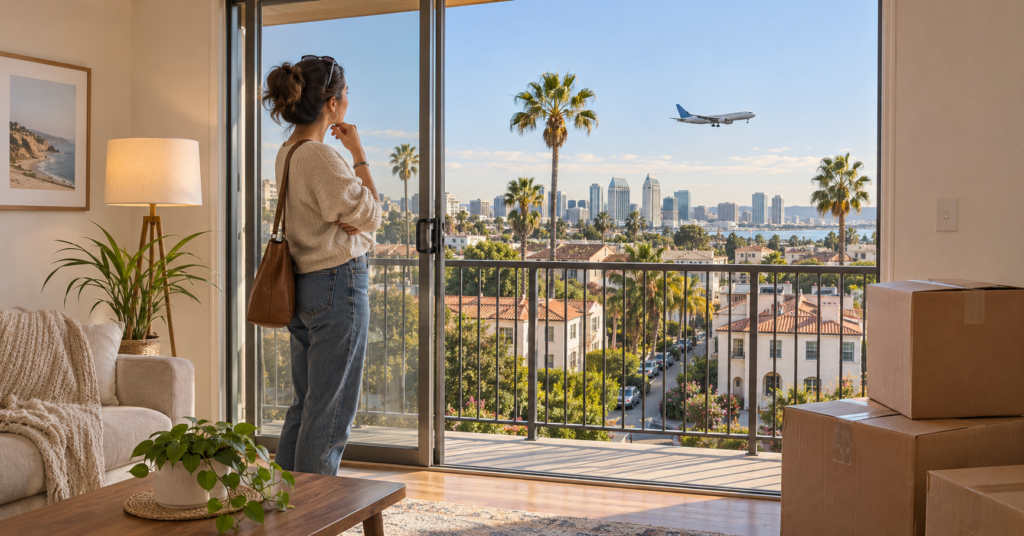
An apartment can look ideal during a short showing: a convenient location, a bright bedroom, and a balcony you would use every evening. Aircraft noise may receive less attention, particularly when no plane passes during the visit.
Moving to San Diego means considering how a home works throughout your day. Flight activity that feels manageable during a weekend viewing may be distracting during work calls, daytime sleep, or a quiet evening outdoors.
Before signing a lease or buying, assess the specific property rather than relying on its distance from the airport or a general description of the neighborhood.
Start With the Address, Not the Neighborhood’s Reputation
A neighborhood label cannot tell you exactly what you will hear from a bedroom or patio. Use the complete address when researching aircraft activity, and evaluate the actual unit you would occupy.
San Diego International Airport provides access to WebTrak through its aircraft-noise page. The tool shows near-real-time and historical flight paths, aircraft altitudes, and recorded noise information. Reviewing different periods can help you understand activity around a prospective home.
Treat flight tracking as background research. It cannot reproduce how sound enters a particular building.
For an apartment, note the floor, bedroom orientation, and outdoor space. A showing in a model unit does not establish what conditions will be like in the unit offered to you.
Understand What Airport Noise Maps Actually Show
Noise contours are useful planning tools, but they are easy to misread.
California uses Community Noise Equivalent Level, or CNEL, to describe cumulative noise exposure. It accounts for activity over time and gives additional weight to evening and nighttime events. It is not a prediction of the loudest individual aircraft you will hear.
A property outside a mapped contour can still experience noticeable overflights. Likewise, a contour does not tell you whether a particular noise level will interrupt your conversation or feel acceptable to your household.
SAN’s property disclosure form allows airport staff to identify an address’s relationship to the current noise contour. The form also recognizes that people differ in their sensitivity to environmental noise.
Use maps to identify questions for a visit, not as a substitute for listening.
The Departure Curfew Does Not Guarantee Quiet Nights
San Diego International Airport’s nighttime departure curfew generally runs from 11:30 p.m. to 6:30 a.m., subject to applicable exceptions. It is a restriction on departures, not a complete overnight closure. Landings are not prohibited during that period.
This distinction matters when someone describes a property as quiet because “the airport closes at night.”
Ask what residents actually hear after bedtime and early in the morning. Avoid assuming that the rule eliminates every aircraft sound or applies to every aviation facility in the region.
For shift workers, nighttime restrictions may be less relevant than daytime activity. Plan your evaluation around when you need to sleep.
Visit During the Hours You Would Use the Home
A short tour can occur between flights. Build in time to observe conditions without rushing through the rooms.
The airport’s own disclosure guidance recommends visiting a property and its surroundings at different times of day and night.
Choose visits around your routine:
- A weekday period when you would work from home.
- An evening when you would use the balcony or living room.
- An early morning or other permitted viewing time relevant to sleep.
During an authorized viewing, ask to pause the conversation briefly. Listen from the bedroom, proposed workspace, and outdoor area.
Record practical observations: whether you stopped talking, missed part of a conversation, or found yourself waiting for a sound to pass. Those notes are easier to compare later than a vague impression that one property seemed “fairly quiet.”
Compare Open-Window and Closed-Window Living
Window position can change the experience of a room. With permission, compare conditions with windows closed and open.
Also establish whether keeping them closed would be comfortable. Check the home’s ventilation, cooling arrangements, and the condition of its window seals and latches.
Ask the landlord or seller:
- Which windows or doors were replaced?
- Was the work specifically intended to reduce aircraft noise?
- Are installation records available?
- Is any equipment needed for comfortable closed-window use?
A phrase such as “upgraded windows” does not explain the complete installation or its performance.
Our guide to California microclimates can help you think through local temperature differences when evaluating how often you might want natural ventilation.
Assess Balconies and Patios Separately
Indoor improvements do not tell you how an outdoor space will feel.
Spend time where you would actually sit, eat, or talk. A balcony that works for a brief morning coffee may be less suitable for frequent calls or long conversations.
Consider how much value you place on that space. Paying more for a terrace makes sense only if you expect to enjoy using it.
This is also a useful way to compare properties without dismissing entire neighborhoods. One home might suit someone who spends most evenings indoors, while another better fits a household that entertains outside.
Ask for Evidence Behind Sound-Insulation Claims
SAN’s Quieter Home Program provides sound-insulation improvements for qualifying properties. Eligibility involves the program boundary and interior noise criteria; proximity to the airport alone does not establish qualification. Tenant-occupied properties can also participate.
When a listing mentions the program, distinguish among three situations:
Work Already Completed
Request documentation showing what was installed and when. Inspect the current condition of the relevant windows, doors, and ventilation equipment.
An Application Is Pending
Ask the owner to confirm the property’s status with the program. A place on a waiting list does not establish when improvements will be completed.
Participation Is Only Suggested
Treat the suggestion as something to investigate. Do not base your housing decision on an assumption that future treatment will resolve a present concern.
The program also states that comparable work completed by homeowners before program treatment is not eligible for reimbursement. Buyers planning immediate upgrades should clarify that point before spending money.
Make Remote Viewings More Useful
Moving to San Diego from another state may limit opportunities for repeat visits.
Ask for a live walkthrough of the exact unit, including a quiet pause near the bedroom window and time on the balcony. Request that background music be turned off during the viewing.
Video can help reveal obvious interruptions, but phone microphones, connection quality, and audio processing make it an imperfect representation of what you would hear in person.
When noise tolerance is a major concern, consider whether temporary accommodation would give you time to inspect permanent options. Compare that additional expense with the difficulty of committing to a home you have not adequately assessed.
Keep a Written Comparison Before Committing
Create a short record for each shortlisted property covering the visit time, window position, rooms assessed, observed interruptions, and any documents received.
Separate confirmed facts from assurances. “Replacement windows installed in the bedroom” is different from “you will get used to it.”
For promised work, request a written description and expected timing. Discuss any purchase conditions or lease commitments with the appropriate real estate professional.
Your decision should reflect the home’s current suitability, including the compromises you are prepared to accept.
Frequently Asked Questions
Does San Diego International Airport close overnight?
No. Its departure curfew generally runs from 11:30 p.m. to 6:30 a.m., with exceptions. Landings are not prohibited during those hours.
Can a home outside an airport noise contour still hear planes?
Yes. A noise contour describes cumulative exposure rather than a boundary beyond which aircraft become inaudible. Evaluate the address and your own response during visits.
Is a quiet apartment showing enough to judge aircraft noise?
No. A brief visit may fall between flights. Return at another relevant time where possible and check the rooms you will use for sleeping and working.
Will the Quieter Home Program make a property silent?
Do not expect silence. The program aims to reduce indoor aircraft noise through qualifying improvements. Confirm the property’s status and assess its present conditions before committing.
What should renters request before signing?
Request a viewing of the exact unit, details of completed sound-insulation work, and written information about any promised improvements. Include outdoor areas in your assessment if they are an important part of the rental.
Note: This article focuses on San Diego International Airport. Other airports and military aviation activity may affect different locations. Flight patterns, program requirements, and property conditions can change. Check current airport guidance and assess the specific home before making a housing commitment.