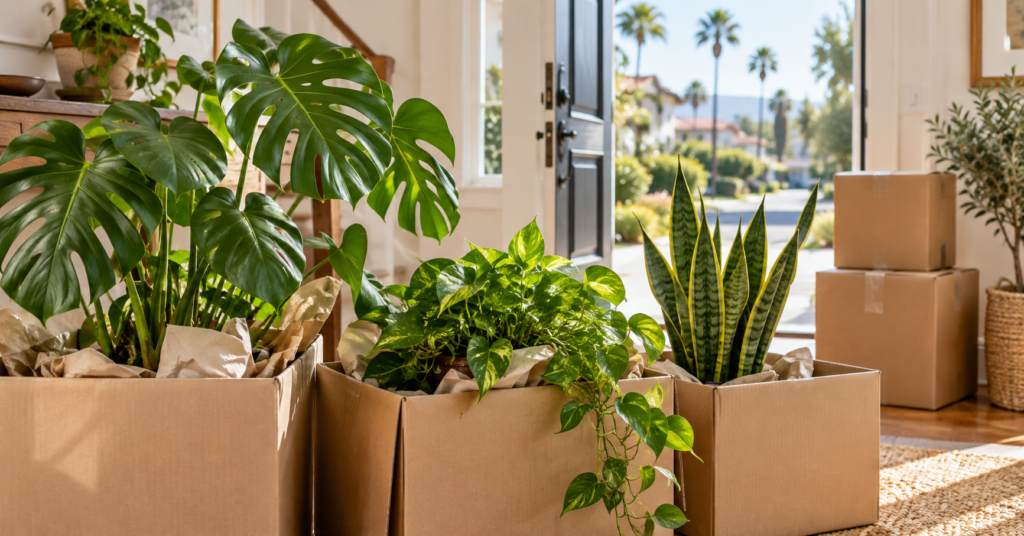
Moving to California with houseplants takes more preparation than finding boxes that fit your pots. Before loading your collection, establish which plants can travel, resolve any inspection requirements and decide how you will care for them during the journey.
This guide focuses primarily on personal household moves from other mainland states. Plants arriving from another country or Hawaii need separate attention because additional federal requirements apply.
Identify Your Plants Before Making Travel Arrangements
Start with a simple inventory containing each plant’s name, approximate size and growing history. Include the scientific name when you know it, especially if a common name could describe several different plants.
Record where each plant came from, whether you have kept it outside and what growing medium is in the pot. Photograph the collection while labels and containers are easy to see.
This gives you something useful to refer to when asking agricultural officials about your particular move. An inquiry describing three identified plants from a specific county is easier to assess than a general question about bringing greenery into California.
Your inventory can also help you decide which plants justify the space and care required during a long journey.
Check the Growing History and Potting Mix
The California Department of Food and Agriculture’s houseplant guidance describes eligible houseplants as indoor-grown plants in sterile, packaged commercial potting mix. Its guidance excludes plants maintained outdoors, including during warmer months, and plants grown in backyard soil.
A plant that spends winter in your living room and summer on a patio therefore needs closer attention. Simply bringing it inside before moving does not establish that it meets the indoor-growing conditions.
Likewise, replacing the top layer of soil does not prove eligibility. If the history or growing medium is uncertain, ask agricultural officials whether an inspection or certification pathway exists before changing the plant’s container.
Separate Restricted Plants From Ordinary Indoor Ornamentals
Do not assume that everything grown in a pot qualifies for the same treatment.
CDFA’s Transporting Plants Into California factsheet, updated September 2025, lists citrus-family plants and propagative parts as prohibited. It also strongly discourages private owners from bringing pine, oak, fruit and nut trees unless all applicable quarantine requirements can be met.
A small potted lemon tree should therefore be flagged separately when planning your move. Taking a cutting is not an automatic alternative, since restrictions can apply to material used to grow another plant.
The factsheet also states that houseplants from areas regulated for certain harmful nematodes are not exempt from those quarantines. Your departure location can matter even when the plant has always lived indoors.
For a specific determination, contact your current state’s agriculture department or CDFA Pest Exclusion at 916-654-0312 or peinfo@cdfa.ca.gov.
Examine Plant Health While There Is Time to Respond
Inspect your collection well before moving day. Look beneath leaves, around stems and in the tight spaces where leaves join the plant.
Fine webbing, sticky residue, cottony deposits or clusters of small insects deserve attention. The University of California’s houseplant problems guide explains how these symptoms can indicate mites, mealybugs, scale insects or other pests. It recommends isolating affected plants and identifying the problem before selecting a treatment.
Avoid treating every yellow leaf as an infestation. Watering problems, unsuitable light and temperature changes can produce similar symptoms. An early examination gives you time to distinguish a care issue from a pest problem instead of making that decision while loading the vehicle.
Confirm How the Plants Will Travel
Before including plants in a moving shipment, ask whether the carrier accepts them and under what conditions. Get clear answers about transit time, possible storage, transfers between vehicles and responsibility for damage.
Describe the actual collection. Several small pots present different handling needs from a tall plant with a heavy container.
If you will transport the plants yourself, measure the available space with passengers and essential luggage accounted for. Check that the tallest foliage fits without being bent against the roof and that nothing will obstruct the driver’s view.
For an overnight journey, plan where the plants will stay during stops. Include the first night after arrival if you will be staying somewhere other than your permanent home.
Pack for Stability and Inspection Access
A practical packing arrangement is to place smaller pots upright in sturdy open-top boxes, with padding between containers to limit movement. Support the pots themselves rather than pressing packing material against delicate stems.
Keep heavy containers low and separate fragile decorative pots when possible. Avoid stacking belongings above foliage or placing loose plants where they could slide during braking.
CDFA instructs commercial movers to put “house plants” at the top of the shipment inventory and position them near the vehicle doors. People transporting their own plants must declare them to border inspectors and make them accessible for examination.
Make sure the person driving knows where the plants are packed and has access to any locked compartment. These are among CDFA’s recommendations for reducing delays at California Border Protection Stations.
Protect Plants From Temperature Extremes
A comfortable departure morning does not guarantee suitable conditions for the entire drive. Consider the weather along the route and the temperatures your vehicle may reach during stops.
The University of Maryland Extension advises against transporting houseplants in a car’s trunk or leaving them shut inside a vehicle during summer. It also recommends shielding foliage from direct sunlight through the windows and wrapping plants for brief exposure to winter cold.
Use that guidance when planning breaks. A shaded parking space is not a reliable substitute for a suitable indoor environment during a long stop. Keep the plants’ needs in mind when choosing your travel schedule and overnight arrangements.
Adjust Watering to the Journey
Do not soak every pot simply because you are about to leave. Check the growing medium and each plant’s needs first, then allow excess water to drain before loading.
Iowa State University’s houseplant care guidance explains that watering needs depend on species, light, temperature, humidity and container conditions. It also warns against leaving roots standing in water.
After arrival, reassess the plant’s position and moisture rather than immediately returning to your old watering schedule. A room with different window exposure, heating or air conditioning may cause the potting mix to dry at a different rate.
Unpack promptly so you can see the condition of the foliage and containers and choose an appropriate place for each plant.
Check Additional Rules for International and Hawaii Moves
For an international relocation, consult USDA APHIS guidance for travelers carrying plants before arranging transport. Requirements depend on the plant, origin and intended use; permits or plant-health documents may be necessary. Agricultural items must be declared when entering the United States.
Moves from Hawaii also require separate planning. APHIS instructs travelers to present plants and other agricultural items for inspection before departure and restricts which materials can reach the mainland. Review its Hawaii travel guidance before deciding what to pack.
Note: Plant-entry requirements and quarantine boundaries can change. Confirm the rules for your plant species, origin and travel method with CDFA and, where applicable, USDA APHIS before moving.