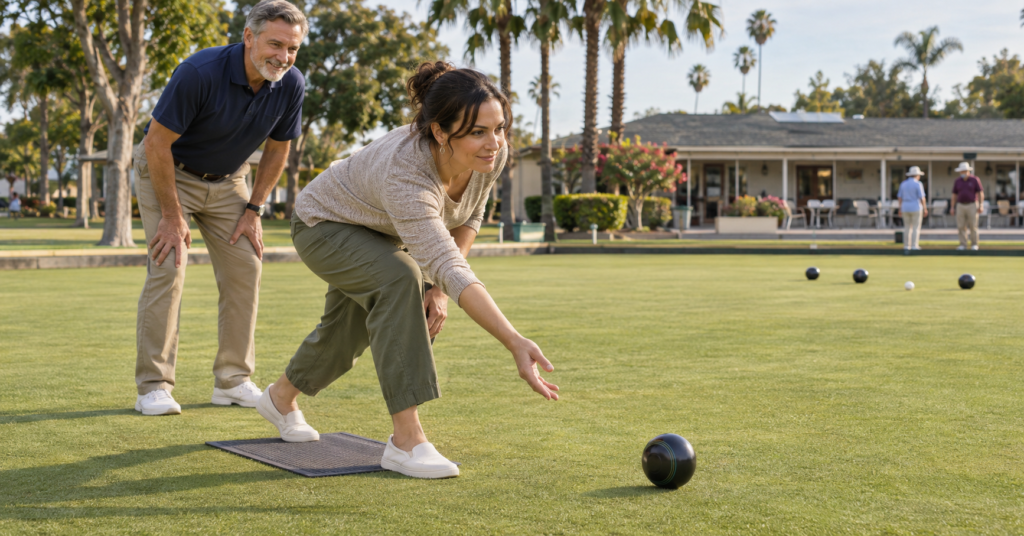
A smooth green, a small white target, and a bowl that curves as it slows can turn a simple-looking game into an absorbing afternoon. Lawn bowling combines careful judgment with conversation, making it an appealing activity for people who want to learn something outdoors.
Long Beach lawn bowling offers a local starting point at Recreation Park. Before your first lesson, a little preparation can help you arrive comfortably, understand the activity, and decide whether it belongs in your regular routine.
Arrange a Beginner Lesson Before Arriving
The Long Beach Lawn Bowling Club lists its location as 1109 Federation Drive. Its beginner information advertises three free introductory lessons covering basic mechanics, rules, and etiquette, with instruction adapted to the learner. Contact the club to arrange a time rather than assuming instruction is available whenever the greens are open.
When making arrangements, mention that you are new and confirm:
- The lesson date and meeting point.
- How early you should arrive.
- The expected session length.
- Whether equipment will be available.
- Any footwear or participation requirements.
A confirmed appointment gives you someone to meet and avoids arriving during a competition or members’ game.
Save the contact details with your booking information so you can check arrangements if circumstances change.
Understand the Aim Before Learning the Technique
Lawn bowling is played by delivering bowls toward a smaller target called the jack. Unlike a perfectly round ball rolling straight ahead, a lawn bowl has a bias that makes it follow a curved path.
Players deliver from a mat. Once an end is completed, the player or team closest to the jack scores for bowls nearer than the opponent’s closest bowl.
For a first lesson, concentrate on the relationship between direction and distance. You are learning where to aim and how much pace to use.
There is no need to memorize every rule beforehand. Knowing the basic objective leaves you free to listen when the instructor introduces scoring, turns, and positioning.
Choose Shoes That Protect the Green
Flat-soled footwear is an important part of lawn-bowling etiquette because it helps protect the playing surface. Bowls USA specifically identifies suitable shoes as a priority for newcomers.
Check your shoes before leaving home. Do not assume that every athletic shoe is suitable; heavily ridged soles or outdoor footwear may be inappropriate for the green. Ask the instructor if you are unsure.
Choose clothing that lets you step, bend, and move your arms comfortably. A restrictive jacket or stiff waistband can become distracting when practicing delivery.
Bring a light layer for cooler conditions, particularly for a late-afternoon session. Our guide to California microclimates explains why coastal conditions can feel different from the weather at your starting point.
Try Equipment Before Buying Your Own
Avoid buying a set of bowls simply to attend an introductory session. Confirm the borrowing arrangements and let the instructor help you assess what feels manageable.
During the lesson, notice whether you can hold and release the bowl comfortably. Explain any difficulty instead of trying to compensate with an awkward grip.
Useful questions include:
- How should the bowl sit in my hand?
- Which markings indicate its bias?
- Is this size comfortable for me?
- How should I place it down between turns?
Keep track of the equipment you use. If one set feels particularly comfortable, ask how to identify it for a future lesson.
A purchase decision becomes easier after you have tried the game and understand your preferences.
Give Yourself One Learning Goal at a Time
Early practice can feel confusing when you try to change your stance, grip, aim, and pace simultaneously.
Ask the instructor which part of the delivery to focus on first. After each attempt, describe what happened in simple terms: the bowl stopped short, traveled too far, or finished on the wrong side.
Then make the adjustment suggested by the instructor and observe the result.
Try not to judge the entire lesson by your closest bowl. A repeatable movement and a clearer understanding of why the bowl followed its path are useful progress.
If several experienced players offer advice, return to the instructor’s main cue. Following one approach at a time makes feedback easier to apply.
Learn Where to Stand Between Turns
The green is a shared playing space. Your position matters even while someone else is delivering.
Ask the instructor to show you where to wait, how to move between ends, and where equipment belongs. Stay aware of nearby play rather than stepping across another player’s line.
Bowls USA’s etiquette guidance emphasizes remaining still and avoiding distractions while someone prepares to deliver.
Wait before picking up bowls near the jack. The result may still need to be agreed or measured.
Keep bags, drinks, and extra clothing in the designated area. A tidy edge around the green makes it easier for everyone to move and concentrate.
Attend Alone Without Feeling You Need a Team
You do not need to recruit a group of friends before asking about an introductory lesson. Explain that you will be attending alone and ask how the session will be organized.
The club describes member draw games in which participants are assigned to teams through a draw. That provides a possible route into social play after learning the basics, although you should confirm membership and readiness requirements first.
For your first visit, keep the social goal modest: learn the instructor’s name, introduce yourself to another participant, and ask how people usually continue after their lessons.
Returning at a consistent time can make a new activity feel more familiar. You do not have to decide immediately whether you want casual games or competitive play.
Discuss Comfort and Access Needs in Advance
Tell the lesson organizer about any practical requirements that may affect participation, such as difficulty bending, standing for long periods, or gripping equipment.
Ask about seating, breaks, the route from parking, and whether an adapted approach or equipment may be available. Confirm the arrangements for the actual session rather than relying on a general description of accessibility.
You can also ask whether observing first is appropriate. Watching how players move around the green may help you decide what questions to raise.
Do not push through discomfort to match another participant’s technique. Let the instructor know what is happening so you can discuss a manageable approach.
Check Weather Arrangements and the Next-Step Costs
For a November outing, establish how cancellations or changes will be communicated. Ask who makes the decision about whether the green is available and when you should check.
Bring water and sun protection appropriate to the conditions. Leave enough time to find the meeting point without rushing.
After the lesson, request current information about membership, equipment access, practice opportunities, and additional charges. Free introductory instruction does not establish the cost of continuing.
Compare those details with your schedule. The most useful hobby is one you can realistically attend, not simply one you enjoyed once.
Frequently Asked Questions
Are beginner lawn-bowling lessons available in Long Beach?
The Long Beach Lawn Bowling Club advertises three free introductory lessons. Contact the club to confirm current availability and arrange a session.
Do I need to buy bowls before my first lesson?
Wait until you have confirmed equipment arrangements. Trying suitable bowls with an instructor is more useful than buying an unfamiliar set beforehand.
Can I attend a lesson by myself?
Ask to book as an individual. You do not need to organize a team before contacting the lesson provider.
Is lawn bowling the same as ten-pin bowling?
No. Lawn bowling involves delivering biased bowls toward a small target on a green. There are no pins to knock down.
What should I wear?
Choose comfortable clothing and flat-soled shoes approved for the green. Confirm footwear requirements when booking.
Will I need to join immediately after a lesson?
Ask about the terms of introductory participation and ongoing membership. Use the lesson to assess whether the activity, schedule, and costs suit you before committing.
Note: Lesson availability, equipment arrangements, membership fees, and weather procedures can change. Confirm current details with the lesson organizer before traveling, and follow the instructor’s guidance on footwear, green access, and suitable participation.