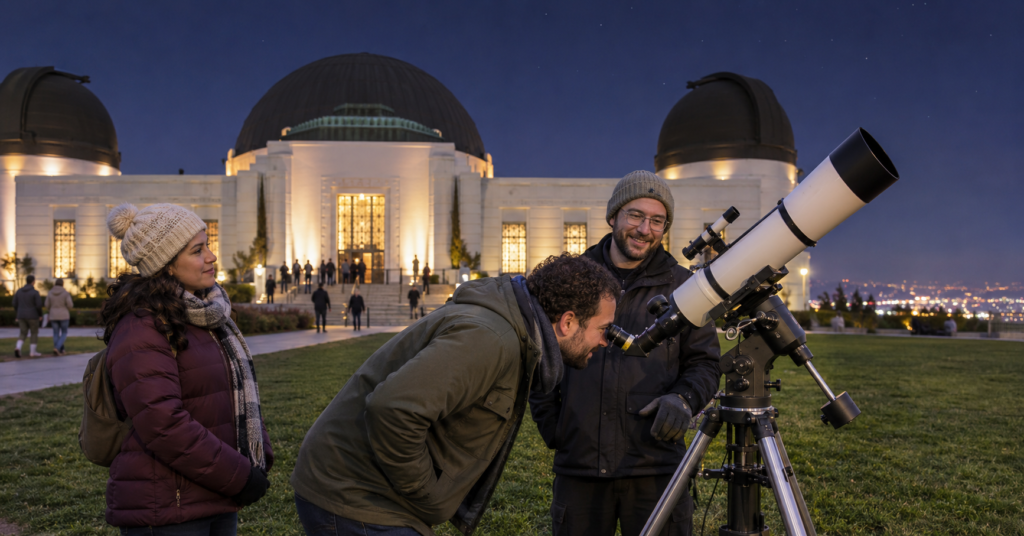
Los Angeles winter stargazing can turn an ordinary evening into a chance to explore the night sky without leaving the city. Griffith Observatory offers a practical starting point, particularly for beginners who would like help using a telescope and understanding what they see.
Earlier darkness makes winter appealing, but sunset alone does not determine when public viewing begins. Telescope schedules, cloud cover, holiday hours, and the journey home all affect the experience.
A little planning helps you build an evening around realistic viewing opportunities rather than arriving with expectations the conditions cannot support.
Check Telescope Hours Separately From Building Hours
The Observatory building and its public telescopes do not follow identical schedules.
Griffith Observatory currently says evening telescope observing usually begins around 7 p.m., when skies are clear and the facility is open. Staff close telescope lines at 9:30 p.m. or earlier so viewing can finish by 9:45 p.m. The building normally closes at 10 p.m.
That distinction matters in winter, when darkness arrives well before the usual telescope session. An early sunset does not mean the telescopes will immediately open.
Check the daily program for your chosen date and leave time to find the observing area. Arriving shortly before the building closes may leave no opportunity to join a telescope line.
If telescope viewing is your main reason for visiting, give it a clear place in your evening instead of fitting it around every other activity.
Review Winter Holiday Closures Before Traveling
A clear evening can still coincide with a closure or shortened operating day.
The Observatory normally opens Tuesday through Sunday and closes on Mondays. Its published winter schedule also includes special holiday arrangements. For 2026, it lists closures on Thanksgiving Day and Christmas Day, with early closing on Christmas Eve and New Year’s Eve.
Use the official calendar rather than relying on an old event listing or a general map entry. Recheck it shortly before departure, particularly if your plans depend on a specific demonstration or show.
When visiting with friends, share the date-specific information with the group. Someone who has visited previously may remember regular hours without knowing about a holiday exception.
Make Cloud Cover Part of Your Decision
Public telescope viewing depends on clear skies. A dry forecast does not necessarily mean there will be an unobstructed view through the telescope.
Look at the hourly forecast for the Observatory area, including clouds, wind, temperature, and rain. Conditions during your planned viewing window matter more than a sunny symbol for the afternoon.
Decide beforehand what would make the trip worthwhile. If you are mainly interested in exhibits and city views, clouds may be less disruptive. If your goal is a first look at a planet through a telescope, choosing another evening may be more satisfying.
Avoid promising children or guests that a particular object will be visible. Weather and the object’s position can both affect what is available.
Choose a Realistic Night-Sky Goal
Start with one or two things you would like to learn rather than a long list of objects you expect to see.
Griffith Observatory’s observing resources explain that the visible sky changes with the time of night, month, and year. Its Sky Report and sky charts help visitors understand what may be observable during a particular period.
You might aim to understand the Moon’s appearance, recognize a bright planet, or learn how to find a familiar constellation. Ask the telescope demonstrator what the instrument is showing and which details to notice.
Give yourself a moment at the eyepiece. Looking briefly and moving away immediately can make it difficult to understand what you have seen.
Do not judge the experience against highly processed astronomy photographs. Approach it as a chance to observe an actual object and learn how to recognize its features.
Dress for Standing Outside After Dark
A comfortable afternoon outfit may feel inadequate during a stationary wait outdoors.
Bring adjustable layers, including a warm outer layer appropriate to the forecast. Closed shoes, a hat, and light gloves can make a longer evening more comfortable when conditions are chilly.
Think about the full visit: the trip from your arrival point, time in a telescope line, and the wait for transportation afterward. A jacket left in a distant vehicle will not help while you are standing on the lawn.
TCG’s guide to California microclimates explains why conditions can change noticeably between neighborhoods and after sunset.
Keep what you carry manageable. A small bag with essentials is easier to handle around crowds than several loose items.
Plan Transportation Around the Return Journey
Getting uphill is only half the travel plan.
The Observatory recommends public transportation and identifies the DASH Observatory/Los Feliz route as an option. It also warns that nearby parking is limited and congestion can lead to road closures.
Before leaving home, check the current transit timetable and your onward connection. Choose a departure time that allows you to reach the stop without rushing.
If driving, consider the walking distance from the parking space you actually find. Do not assume you will park beside the building.
If walking uphill, plan the return route with darkness in mind. A route that feels straightforward in daylight may be less suitable for your group after an evening outdoors.
For a shared ride, review the designated pickup arrangements and keep enough phone battery to contact your driver.
Keep Free Viewing Separate From Paid Activities
Admission to the Observatory building, grounds, and public telescopes is free. Parking and Samuel Oschin Planetarium shows can involve separate charges.
Decide which parts of the visit matter most before adding optional spending. A telescope evening does not require a planetarium ticket.
If you want to attend a show as well, compare its timing with the observing session. Leave room for queues and movement between activities rather than scheduling everything back to back.
An indoor presentation can be an enjoyable part of the evening, but it is a different experience from looking through a telescope at the real sky. Make that distinction clear when planning with first-time visitors.
Consider a Public Star Party for Extra Guidance
A scheduled star party can suit beginners who enjoy asking questions and seeing different instruments.
Griffith Observatory hosts free monthly public star parties with volunteer astronomy groups. These events bring multiple telescopes to the lawn and provide opportunities to discuss observing with experienced participants. Check the calendar for the selected Saturday rather than assuming they happen every weekend.
Ask what each telescope is pointed toward before joining its line. Several instruments may show different targets or offer different views of the same object.
You do not need to bring your own telescope. The Observatory specifically prohibits operating private, unauthorized telescopes on its grounds.
Make the Viewing Session Comfortable for Your Group
Discuss any mobility, standing, or viewing needs before the trip. Check the Observatory’s accessibility information and contact staff if you need to understand arrangements for a particular telescope or program.
At the instrument, follow the demonstrator’s instructions. Ask before touching controls, moving equipment, or attempting to photograph through the eyepiece.
Keep phone brightness low around people observing and avoid directing a flash toward them. Leave enough room for others to move through the area.
For children, one patient, well-explained view may be more rewarding than several rushed queues. Allow time afterward to talk about what they noticed.
Keep an Indoor Alternative Without Overloading the Evening
If clouds interrupt observing, the Observatory’s exhibits and scheduled talks can still provide something useful to explore. Its daily program includes activities beyond telescope viewing, although availability depends on the operating schedule.
Choose one alternative in advance, such as exploring an exhibit or attending a talk. This keeps a change in conditions from turning into a hurried search for another plan.
Afterward, write down one object you observed or one question you would like answered next time. Los Angeles winter stargazing can become a repeatable local activity, with each visit building a little more familiarity with the sky.
Note: Telescope operations depend on weather, and schedules may change. Check Griffith Observatory’s official daily programs and visiting information before departure.