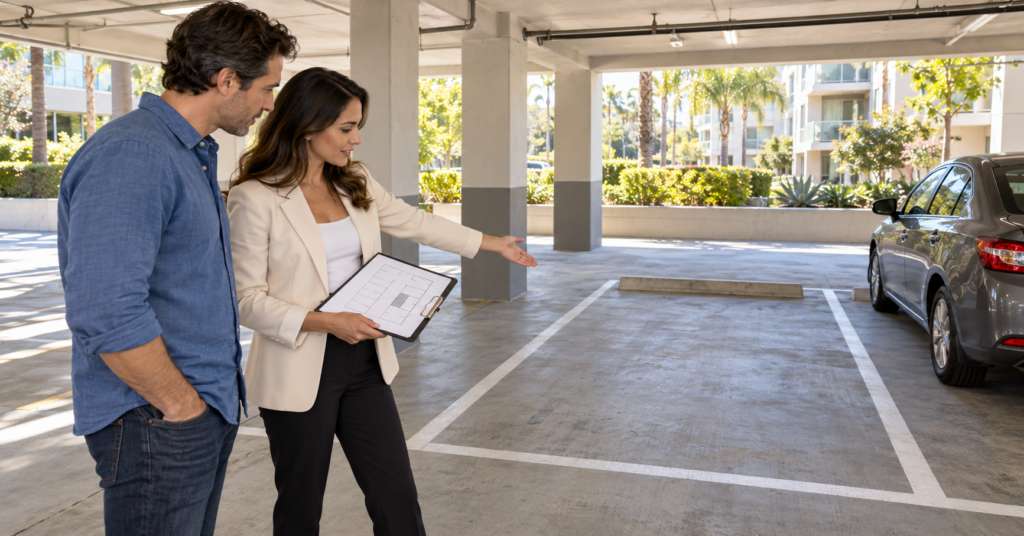
California condo parking can look straightforward during a showing. The agent points to a numbered space, the seller parks there, and the listing advertises parking for one or two vehicles.
The important question is what right the buyer will receive. A space might be part of the property interest, an exclusive-use area, an HOA assignment, or a separate rental arrangement. Those differences affect how the space can be used and whether the arrangement continues after the sale.
Before closing, connect the physical space to the documents supporting its use. Then check whether it works for your vehicle, schedule, and household.
Identify the Type of Parking Right
Ask the seller and your agent to explain what “parking included” means for the specific property.
California’s Department of Real Estate explains that common areas can be designated for an individual owner’s exclusive use, including parking spaces. An exclusive-use right is different from separately owning the underlying area.
Common descriptions deserve different follow-up questions:
| Parking description | What to establish |
|---|---|
| Deeded parking | What the deed actually conveys and which documents identify the space |
| Exclusive-use common area | Which unit benefits from the right and what restrictions apply |
| HOA-assigned parking | How the assignment was made and whether it can change |
| Leased parking | Who owns the space, what it costs, and whether the lease transfers |
| Shared or unassigned parking | Whether a space is guaranteed and how availability is managed |
These labels are starting points. Ask the professionals reviewing the transaction to identify the legal arrangement rather than relying on the wording in an advertisement.
Match the Space to the Deed and Condo Plan
Walk to the actual parking space and record its number, location, and layout. Compare those details with the relevant deed references, condominium plan, and HOA records.
A painted number is useful for finding a space, but it does not resolve conflicting documentation.
DRE has identified discrepancies involving parking counts and exclusive-use areas among problems that can arise in subdivision documents. That makes consistency worth checking, even when everyone appears confident about the arrangement.
Ask your title professional or real estate attorney to investigate if the documents describe a different space, refer to an unclear exhibit, or omit a claimed parking right.
Avoid accepting “the building has always used these numbers” as the only explanation. Request the document or approved record connecting the space shown during the viewing to the unit being purchased.
Investigate Informal Parking Swaps
Neighbors sometimes exchange spaces because one spot is easier to access or closer to an elevator. The seller may therefore use a space different from the one associated with the condo.
Ask directly whether any swap, borrowing arrangement, or permission from another owner is involved.
If so, request the agreement and establish whether the HOA approved it where required. Ask an appropriate adviser whether the arrangement can continue after the property changes hands.
For example, a seller might use a wide corner space while allowing a neighbor to use the seller’s narrower space. The buyer should evaluate the space supported by the purchase documents unless the alternative arrangement is properly addressed.
Do not pay a premium for a convenient location based only on an informal understanding between existing residents.
Review HOA Parking Rules Separately
A documented right to use a space does not answer every question about what can happen there.
Obtain the current parking rules and relevant provisions in the declaration, commonly called the CC&Rs. Check for restrictions affecting:
- Vehicle dimensions or types.
- Tandem parking and vehicle movement.
- Storage cabinets, bicycles, or other belongings.
- Vehicle repairs and washing.
- Renting a space to another person.
- Guest parking and overnight visitors.
Ask about pending changes and existing disputes that could affect your intended use.
If the space is assigned by the association, ask what authority governs assignments and reassignment. Avoid assuming either that every assignment is permanent or that the board can freely change every parking right.
The answer depends on the property’s documents and applicable law.
Test the Garage With Your Actual Vehicle
Once the paperwork is understood, assess everyday usability.
With permission, bring the vehicle you expect to park there. Check the route from the street through the gate, ramps, turns, and entrance to the space.
Measure the narrowest points and account for mirrors, roof racks, charging ports, and the room needed to open doors. A vehicle may fit inside the painted lines while leaving too little room to install a child seat or unload groceries.
For tandem spaces, work through who would need to move a vehicle and when. For mechanical parking systems, request the operating instructions, vehicle limits, maintenance arrangements, and procedures during a breakdown.
Record any physical limitation that would change your buying decision. A space described as “two-car parking” may still be inconvenient for the household’s particular vehicles.
Check Leases, Fees, and Transfer Conditions
If parking is rented separately, request the lease rather than treating the monthly payment as an ordinary HOA charge.
Review its duration, renewal terms, price changes, termination provisions, and any conditions for transferring it to a purchaser.
Ask who must approve the buyer and when that approval can be obtained. A seller’s existing arrangement may not establish that the same space will be available on the same terms after closing.
Also identify charges for access devices, additional vehicles, parking services, or equipment maintenance.
For broader purchase budgeting, TCG’s guide to three-bedroom home costs in San Francisco discusses how parking arrangements fit into the comparison between properties.
Ask Who Maintains the Parking Area
Clarify responsibility for the parts of the parking arrangement that may need work: garage doors, gates, pavement, drainage, lighting, mechanical equipment, and any private enclosure.
Exclusive use alone does not give you a complete maintenance budget. Review the governing documents and ask the HOA to explain how responsibilities are allocated.
Request information about planned garage work and any associated assessments or temporary closures. Board minutes, budgets, and reserve materials may help identify projects that are already under discussion.
If a major repair is expected, ask where residents would park during the work. An alternative space may carry additional cost or be unsuitable for your household.
Investigate EV Charging Before Relying on It
An existing outlet near a parking space should prompt questions about authorization, electrical capacity, and billing.
Ask whether the charger or outlet serves the particular unit, whether installation records are available, and who owns and maintains the equipment.
If you plan to install charging, request the HOA’s application process and arrange a qualified assessment of the proposed installation. California provides protections for qualifying charging installations under Civil Code Section 4745, but the particular project still needs review for applicable conditions and requirements.
Obtain a realistic scope and estimate before making charging availability a reason to buy. Distance from the electrical supply and the building’s existing infrastructure can affect the project.
Resolve California Condo Parking Questions Before Closing
Bring unresolved findings to your agent, title professional, and attorney where needed while there is still time to address them within the transaction.
A useful written request identifies the discrepancy: the listing promises two spaces, the seller uses spaces 14 and 15, but the available documents identify only space 14.
Ask what evidence or corrective action is needed. A general reassurance from management may help explain building practices without resolving a title or transfer question.
Before the final walkthrough, confirm which access devices will be delivered, whether another person must remove a vehicle or stored belongings, and who will update the building’s parking records.
The handover should leave you knowing which space you can use, the basis for that right, and how to access it from the first day of ownership.
Note: California condo parking rights depend on the property’s recorded documents, agreements, and applicable law. DRE’s Guide to Understanding Residential Subdivisions in California provides background on condominium ownership and common areas. Have unclear parking rights reviewed before relying on them in a purchase.