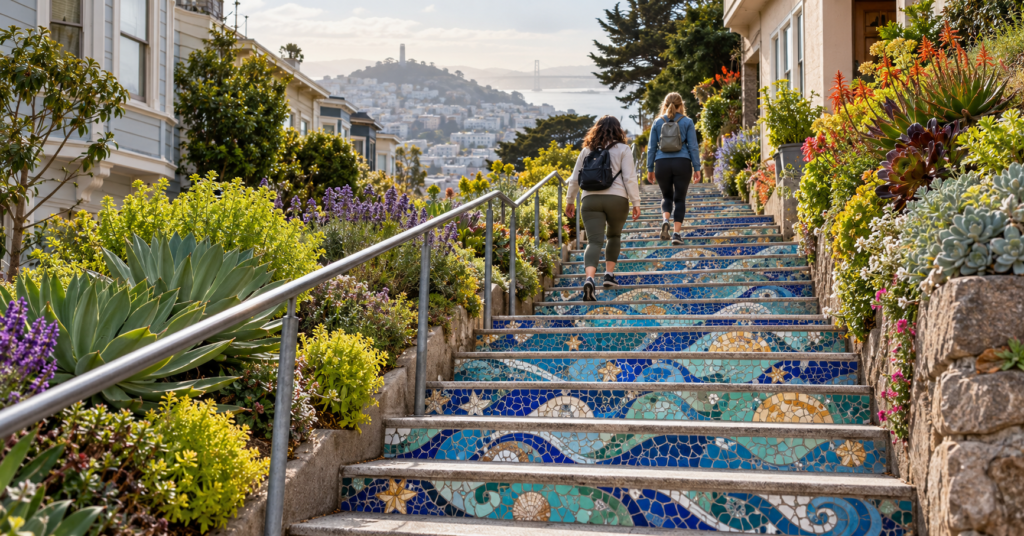
San Francisco stairway walks offer a different way to explore the city: through mosaic artwork, residential gardens, hillside passages, and viewpoints that are easy to miss from a car.
For a first outing, choose one main staircase and plan the streets connecting it to your arrival and departure points. A short distance on a map can involve a substantial climb, and reaching the top does not necessarily mean the uphill walking is finished.
A manageable route gives you time to notice the artwork, enjoy the surroundings, and find out which kinds of walks you would like to try next.
Choose One Stairway as Your Main Destination
Decide what you want from the outing before collecting locations. Mosaic details, gardens, neighborhood exploration, and panoramic views can lead to different choices.
Three possible starting points are:
| Stairway | Location | Main attraction |
|---|---|---|
| Hidden Garden Steps | 16th Avenue between Kirkham and Lawton streets | Colorful mosaic artwork and surrounding planting |
| 16th Avenue Tiled Steps | Moraga Street between 15th and 16th avenues | A mosaic composition progressing through sea and sky imagery |
| Lincoln Park Steps | California Street and 32nd Avenue | Decorative tile panels and a distinctive broad staircase |
The Hidden Garden Steps and the 16th Avenue Tiled Steps are separate destinations. Saving the correct intersection prevents an avoidable detour. San Francisco Travel identifies all three locations in its neighborhood guidance.
For a first visit, treat nearby attractions as optional additions. You can enjoy one staircase without turning the afternoon into a cross-city itinerary.
Check Elevation Along the Whole Walking Route
Look beyond the number of steps at the destination. Your route may include a steep approach, additional stairs above the artwork, or an uphill walk back to transit.
Review the arrival route and the return separately. Note where you can stop, shorten the walk, or change direction.
If you are visiting with friends, describe the terrain when making plans. “A short walk” can mean very different things to someone expecting level sidewalks and someone accustomed to hills.
TCG’s guide to San Francisco culture shocks explains why walking distance alone can be misleading in the city. Use that same approach when comparing possible stairway outings.
A lower starting point lets you see how the climb feels as you go. However, descending stairs can also be demanding, so allow time and energy for both directions.
Keep the Grandview Park Extension Optional
The 16th Avenue Tiled Steps can be part of a longer outing toward Grandview Park, but the mosaic staircase and the park’s summit should be treated as separate stages.
San Francisco Recreation and Parks describes the park climb as largely consisting of wooden stairs. It also asks visitors to remain on established paths and stairways to protect fragile habitat and reduce erosion.
Decide at the top of the mosaic steps whether everyone wants to continue. Consider energy, daylight, weather, and the remaining journey home.
If the artwork was your main reason for visiting, finishing there is a complete outing. You do not need to add a summit simply because it appears nearby on the map.
Plan San Francisco Stairway Walks Around Daylight
Choose a start time that leaves room for an unhurried return. Photo stops, conversations, and rest breaks can make an outing longer than a map’s walking estimate.
Check the destination’s current visitor guidance and any posted access restrictions. Public access should not be interpreted as an invitation to visit every staircase at any hour.
The community group maintaining the 16th Avenue Tiled Steps notes that the steps have no lighting and can be slippery.
Review the local forecast before leaving. Carry a light layer that you can remove during the climb and put back on when you stop.
If wet conditions, poor visibility, or strong wind would make the planned route uncomfortable, shorten the outing or choose another day. A clear view is a possibility, not something a timetable can guarantee.
Wear Shoes That Suit Steps and Slopes
Choose comfortable footwear with secure support and a sole that grips the surface. Shoes that work for a restaurant visit may be less comfortable on repeated climbs and descents.
Keep what you carry light. Water, a small snack, a charged phone, and an extra layer are usually more useful than a large bag filled with unnecessary items.
Leave a hand available for a railing where one is provided. Pause before checking your phone or adjusting your camera rather than doing either while walking down steps.
If you use a mobility aid or need a step-free route, investigate access before choosing a stairway destination. Being able to reach the bottom does not establish that the full route is accessible. A street-level view of the artwork may suit some visitors, but the approach itself still needs checking.
Respect Gardens and Residential Entrances
Many stairways pass close to front doors, windows, and gardens. Walk with the same consideration you would want outside your own home.
Keep voices low, leave entrances clear, and avoid stepping into planted areas for a better view. Stay on the public route rather than following a side path that may lead to a residence.
At the 16th Avenue Tiled Steps, the neighborhood group specifically asks visitors to take away rubbish, protect the plants, keep dogs leashed and out of gardens, and avoid obstructing driveways.
Small groups are easier to accommodate on narrow passages. If you stop to talk, choose a place where others can pass without moving into planting beds or the street.
Take Photographs Without Blocking the Staircase
Look for a position where you can photograph the artwork while keeping the walking route open. Wait for a gap in foot traffic instead of asking everyone to stop.
Take turns if several people want portraits. Avoid placing bags or equipment across a landing, and do not stand in the roadway to fit more of the staircase into the frame.
The colorful risers often reward a closer look. Photographing a small detail can be just as satisfying as trying to capture the entire staircase.
For an organized shoot involving equipment, models, or commercial work, check the applicable location and city requirements beforehand. Do not assume arrangements for an ordinary visit cover a larger production.
Arrange Transit and the Return Before You Start
Choose your departure point as carefully as your arrival point. Returning to the same stop may be convenient, but it could also add another hill or require retracing a long section.
SFMTA’s trip-planning resources provide bus and rail options, route maps, and accessibility information. Check current service for the day you intend to travel.
Save the relevant stop names and a screenshot of your planned route. If someone becomes tired, having an alternative departure point already identified makes the decision easier.
Drivers should check parking restrictions and avoid blocking residential access. Leave belongings out of sight before arriving rather than rearranging valuables beside the parked car.
Identify Restrooms and a Comfortable Finish
Do not assume a popular staircase has visitor facilities. The 16th Avenue Tiled Steps’ community guidance states that there are no public restrooms at the site.
Find a suitable restroom option before starting, particularly when walking with children. Check access and opening hours rather than assuming a nearby business will provide facilities.
Choose a relaxed finishing point, such as a neighborhood commercial street or a transit stop with an easy onward journey. Build in enough time to sit down if needed.
After the walk, note what worked: the amount of climbing, the pace, the arrival route, and whether you preferred artwork or views. Those observations give you a useful starting point for planning your next San Francisco stairway walk.
Note: Access, maintenance conditions, and transit service can change. Check posted signs and current local guidance before setting out. Use the SFMTA trip planner to arrange your journey to and from the neighborhood.