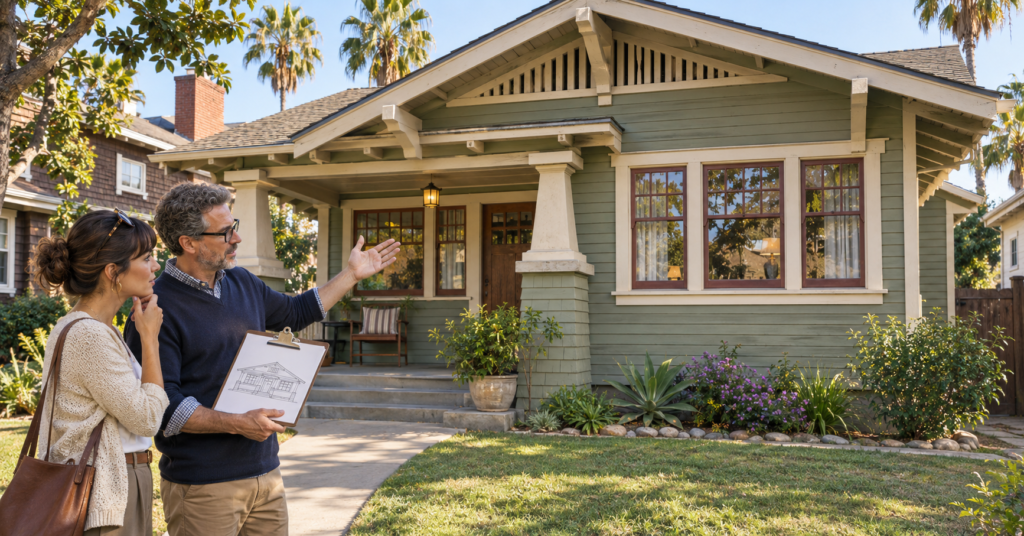
A shaded porch, original windows, and distinctive roofline can make an older Long Beach property stand out. Those same features may also influence which repairs and renovations a future owner can undertake.
Long Beach historic homes deserve a closer review before purchase, particularly when your plans include changing the exterior. A project that seems straightforward elsewhere may need preservation approval, specific materials, or a different design.
The useful question is whether the property’s requirements fit your plans, budget, and preferred maintenance approach.
Confirm the Property’s Historic Status
Start with the exact address rather than the listing’s description. “Vintage,” “Craftsman,” and “historic charm” are marketing terms; they do not establish the property’s official designation.
Long Beach directs owners to its historic-district and landmark maps to check status. Its Planning Bureau also advises reviewing guidelines for both the district and the building’s architectural style.
Ask city staff to clarify whether the property is:
- An individually designated historic landmark.
- A contributing building within a historic district.
- A non-contributing building within district boundaries.
- Subject to another property-specific designation or condition.
A newer or heavily altered building inside a district is not automatically exempt. The city’s Permit Center states that exterior changes require review regardless of whether the building itself is considered historic.
Separate Historic Approval From Building Permits
Long Beach uses a Certificate of Appropriateness, commonly called a COA, to review changes affecting historic properties.
The city requires approval for exterior changes to designated landmarks and properties in historic districts before work begins, even when a building permit is unnecessary. Its examples include window and door changes, repainting, reroofing, additions, and solar installations.
This creates two questions for a proposed project: whether preservation approval is needed and whether construction permits are also required.
Do not treat a contractor’s statement that “this job does not need a building permit” as a complete answer. Describe the work to Historic Preservation staff, including materials, dimensions, colors, and affected elevations.
The city’s published process places COA approval before submission of construction plans to Building Safety. Account for that sequence when planning your move-in schedule.
Review Previous Alterations Before Closing
A freshly renovated exterior may look reassuring, but appearance alone does not establish that the work was approved.
Request records for visible changes such as replacement windows, porch alterations, new doors, siding, fencing, or a roof replacement. Useful documents include:
- Issued COAs and attached conditions.
- Approved drawings and product specifications.
- Building permits and inspection records where applicable.
- Contractor invoices identifying installed materials.
- City correspondence concerning unresolved work.
Compare the paperwork with the property. An approval for one design may not explain a different product installed later.
Missing records do not automatically prove a violation. They do identify a question worth resolving during due diligence. Ask your real estate professional to help request clarification rather than assuming the age of an alteration makes it acceptable.
Assess Windows and Doors Before Pricing Replacements
Window condition can become a significant budgeting issue when a buyer expects to replace every unit immediately.
Long Beach’s preservation guidance favors retaining and repairing original architectural features. When deterioration warrants replacement, the proposed replacement is assessed for compatibility with the historic feature.
Get a Condition Assessment
Ask someone experienced with older windows to distinguish repairable problems from extensive deterioration. Request an itemized scope covering operation, damaged components, glazing, and finish work as relevant.
Confirm the Proposed Product
Before paying a deposit, establish whether the intended frame material, profile, opening pattern, and dimensions are acceptable.
The city allows consideration of substitute materials for certain non-contributing buildings and detached new construction, subject to compatibility review. This is not blanket permission to use the same product on every historic property.
Include Roofs, Porches, and Trim in the Inspection
Historic character extends beyond the front door. Long Beach’s design guidance identifies window proportions, entrances, porches, roof forms, eaves, chimneys, and trim among features relevant to preservation review.
During inspection, ask which elements need attention soon and which can remain under routine maintenance.
A roofing estimate should distinguish replacing the covering from altering the roof shape or removing architectural details. Similarly, a porch repair should identify whether the proposal retains existing features or changes their appearance.
Photographs are useful when seeking early guidance. Capture the whole elevation as well as close views of the damaged area so staff can understand its relationship to the house.
Check Paint Choices Before Scheduling Move-In Work
Exterior painting can feel like an easy first project after closing, but it belongs in the approval discussion.
Long Beach has a dedicated exterior-paint COA application. Its guidance calls for colors compatible with the property’s architectural style and historic setting.
Prepare a clear color schedule showing the proposed treatment of siding or stucco, trim, doors, and other details. Avoid giving a painter a broad instruction such as “make everything white” before the proposed scheme has been reviewed.
Also separate painting from surface alterations. Removing decorative trim, covering brick, or changing an exterior finish may involve decisions beyond color selection.
Test Addition Plans Before Buying for Expansion
A large lot does not establish that your preferred addition will be approved.
Long Beach’s guidelines emphasize preserving significant materials, architectural features, and the character of the building and district. The design of an addition therefore deserves early consideration alongside zoning and construction requirements.
Bring a basic concept to the discussion: approximate size, location, height, and how the addition would connect to the existing house.
Ask a designer to identify alternatives if the first concept creates preservation concerns. Moving an addition, reducing its height, or changing its connection to the original building may affect both cost and usability.
Evaluate whether you would still want the property if the expansion takes longer, costs more, or needs a substantially different layout.
Examine Any Mills Act Contract Separately
Historic designation and Mills Act participation are different matters.
Long Beach’s Mills Act program offers potential property-tax relief in exchange for preservation, rehabilitation, and maintenance commitments. The city states that existing contracts transfer to new owners when a property is sold.
When a listing advertises Mills Act benefits, request the recorded contract, work schedule, reporting records, and any outstanding requirements.
Budget for the obligations as well as the potential benefit. Do not assume the seller’s tax bill predicts your own result or that every historic property automatically receives relief.
Confirm property-specific tax questions with the appropriate assessor and contract questions with city staff before relying on projected savings.
Build a Budget Around the Actual Scope
Separate your first-year budget into urgent repairs, ongoing upkeep, and optional changes.
Obtain estimates that identify the materials and methods being priced. A low quote based on an unreviewed replacement product may be difficult to compare with a proposal that preserves existing features.
Allow for assessment, design documentation, application costs where applicable, and possible revisions. Request current review guidance rather than assuming every project requires a commission hearing; Long Beach provides separate applications for staff-reviewed minor work and major alterations.
Our guide to California home maintenance can help organize the wider upkeep budget alongside preservation-specific work.
Frequently Asked Questions
Does every old Long Beach house require historic approval?
No. Age alone does not establish designation. Check whether the address is a landmark, lies within a historic district, or has another applicable historic status.
Can a non-contributing house still need a COA?
Yes. Long Beach applies exterior review to properties within historic districts even when the individual building is not considered historic.
Do interior renovations require historic review?
Ordinary interior alterations generally do not, but certain landmarks have designated interior features that are also reviewed. Building permits may still be necessary. Check the specific designation and proposed scope.
Can I replace damaged windows with any similar-looking product?
Do not assume so. Have the condition assessed and confirm the proposed replacement’s specifications with Historic Preservation staff before ordering.
Does a historic home automatically qualify for lower property taxes?
No. Mills Act participation requires a separate contract and qualifying circumstances. Verify an existing contract or current application eligibility rather than relying on the home’s age or location.
Note: Historic designations, review procedures, and property-specific conditions can affect what work is permitted. Confirm current requirements with Long Beach Historic Preservation staff before purchasing materials or starting alterations. This article provides general planning information, not a determination of approval for a particular property.